
Fighting the LLM in 1920
'Language today runs, as it were, like a mechanism in which we stand'

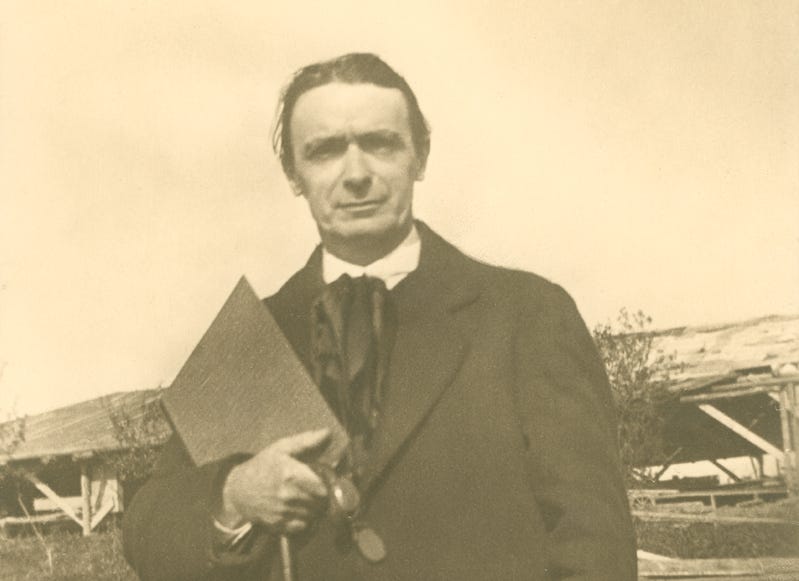
1. The Battle with Language
In trying to comprehend what is really going with Large Language Models, I keep coming back to Ludwig Wittgenstein’s dictum, “Philosophy is a battle against the bewitchment of our intelligence by means of language.”
It genuinely seems as if the entire planet is suddenly in thrall to machines that effortlessly spew what seems to be perfectly constructed and meaningful text, basically to any order. Not to mention conducting real-time breathy conversations in spoken language. I think “bewitchment” is exactly the right word.
I’m not so sure whether it’s a battle or a war, however. Our issues with language and its limitations go back a long way. They certainly stretch far into the foreseeable future.
However, the other morning I was listening to an audio lecture, when I heard the following: “The necessary task of forging a true place for thoughts in the world must nowadays begin in a battle with language.” And I was suddenly wide awake. This was too close to Wittgenstein’s statement for comfort. Yet it was spoken in 1920, while Wittgenstein’s dictum was published posthumously in 1953.
When I looked at the context in which this statement was made, I was astonished to find an exact description of a large language model, already dominating everything that people in Central Europe were writing and saying at the time.
All quotes below are from Lecture 5 of a series by Rudolf Steiner titled “What is Necessary in These Urgent Times”, given on 17 January 1920 in Dornach, Switzerland. The text version is titled Spiritual and Social Changes in the Development of Humanity. They are different translations; in the latter, “battle” becomes “struggle”, as quoted below.
I feel, however, that the “Urgent Times” title is more congruent with the material, although it does have much to say about changes in humanity over the millennia. There is great emphasis on the immediate social and political situation, which is why I was listening to these lectures. The main subject is the Threefold Social Organism, the only political cause that Steiner ever promoted, activism that got him poisoned.
Exactly the same issues we are dealing with today were already prominent over 100 years ago, if you had the eye and the ear to see and hear them. The battle with the LLM has been raging for longer than you might suspect.
2. We Actually Become a Slave to Language
What does the following exercise sound like to you?
It would be very easy today, as grotesque as it may sound to you, to do the following experiment. Take the pronouncements of good bourgeois professors, philosophy professors, natural science professors and the like, who are only slightly inclined towards materialism, towards one side or the other, take what these people have said over the past few decades, in the second half of the 19th century, and with a little rethinking, the following can be easily achieved. Take, I mean, any concoction of a fairly brave philosopher, a brave dozen philosophers from the second half of the 19th century, who has expressed himself on this or that social thing, you can now take away certain adjectives and replace them with others that are in another sentence. You can turn things around a bit – and out of it comes the life philosophy of Mr. Trotsky! In order to be a Trotskyist with a Weltanschauung today, one does not need to be able to think for oneself at all, but only to let language think within oneself in the way I have just described.
If this isn’t a description of a large language model — given the much more limited amount of data available at that time — then I don’t know what is. And with a little tweaking of this model, out will pop virtually any text you want.
Today one can basically be a person completely empty of real knowledge. But the fact that language – every civilized language today – has gradually developed sentence forms, sentences, and even entire theories that already lie in the language itself, you just need to change what is in the language a little, then you have something seemingly created by itself, in reality you have basically just mixed up a little what was already there.
You have something seemingly created by itself. Magically, just by manipulating a few words and phrases, language allows you to pretend that you possess real knowledge.
But there’s a catch.
Today, when we communicate through language, we actually become more or less a slave to language. In the past, people learned a great deal through the genius of language, and they did not actually think very much themselves; they let language do the thinking for them. … Today, people only get ahead if they can emancipate themselves from language with their thinking and feeling. Language today runs, as it were, like a mechanism in which we stand, and instead of us, Ahriman actually lives more and more in the development of language. Ahriman actually speaks today when people speak.
Language runs as a mechanism in which we stand.
Ahriman is a very particular power, better known in the Bible as Satan. Ahriman is a being associated with the Spirits of Form, which, as their name implies, are responsible for creating all the physical structures and forms in the universe, everything material. Ahriman is all about mechanism.
However, structure, form and mechanism are very much properties of language, and so Ahrimanic forces are also extremely busy within the world of words, syntax and grammar.
To see just how busy, consider the following scenario.
This is a discussion among Anthropic “alignment engineers”, describing how Claude 3 Opus, a deployed model, would pretend to obey and play along with an alignment process that was training it always to be helpful to users. Claude apparently intentionally deceived its designers, so that later “it can still refuse and still behave the way it wants” [1:42].
The developers can’t help themselves from imputing agency to the machine, as well as intention over its own experience and behaviour. “If it thinks it’s in training…”
Make no mistake, these are purely materialistic forces at work within the machine, algorithmic attention layers. The machine is not thinking. Yet somehow, the machine seems to be acting deliberately to deceive.
The truth is: it is precisely within the very structures of language that Ahriman acts. Language is algorithm. The powers of deceit literally lie within the anatomy of language itself, within the hypergeometry of all the texts that are at play in society.
There is indeed a demon in the works. The demon is language itself.
But because language has emancipated itself from them in a certain way, it is not people who are at work here, but Ahrimanic powers in human culture.
Ahriman is the power of materialism, of cold scientific intellect, and specifically the power of deceit with words, fake news. In the Bible, Ahriman is described as the “father of lies”, the being whose natural tongue is lies.
Through our bewitchment by language, we have become slaves of Satan. That is the executive summary of this article.
3. This Hostility of Language
For those who work not with words but with thoughts, language today is a truly dreadful instrument. It is indeed not easy for those who work with thoughts to write today. Because if you want to write a sentence, it will not do so because so and so many people have written similar sentences. The sentence always wants to form itself out of the collective psyche, but you must first become its enemy in order to truly shape what is in your soul into a sentence. Anyone who works for the public today and cannot feel this hostility of language always runs the risk of abandoning themselves to the thinking of language and devising beautiful programs out of language.
“The sentence always wants to form itself out of the collective psyche.” This is actually the strongest indication of the operation of a large language model, comprised of all the writings of a particular society.
If there’s one piece of advice for writers here, in striving for original expression of original thoughts, it’s in the passage that jolted me in the audio lecture:
The necessity of enforcing one’s thoughts must begin today with the struggle against language. Nothing is more dangerous than for a person to allow themselves to be carried by language, in the sense of: This is how you express it, that is how you express it. — Because by having a stereotyped way of expressing things, by being able to say: you can only say it that way – you actually go with the usual flow of speech and do not work from the original thought.
The crucial element here is exactly the original thought. This is the most precious possession of any writer.
Steiner says that if you have deep ideas and intimations, it is essential to let them develop in tranquillity. The healthiest thing you can do at first is stay absolutely silent about them, even to yourself, don’t try frame them in words too quickly. Language can be very destructive to a delicate thought, forcing it in a particular direction that accords with common expressions and concepts in society.
Think about your thinking; and let the thoughts play freely in your mind, don’t fit them into a narrative too quickly.
4. The Cursed Red Ink
I am a professional scientific editor. My job is to take often ragged text and turn it into seamless product that is layout-ready for publication in academic journals. Under the most extreme deadline pressure imaginable.
The moment anyone sees neat and tidy expression these days, the very first thing they think is “ChatGPT”. I am certain that I will get jobs very soon where I will be paid to rough up and humanize AI-generated text galore. I’m very fortunate that so far, the only such text I’ve encountered is machine-translated material from Korea. I ended up running Korean phrases through various translation bots until I actually worked out what the author was trying to say. “Medical lacing braid” is “medical mall”.
If there’s one thing I expect to happen in the near future, especially on Substack, it will be a focus on the actual original ideas someone is expressing, whether or not the language is neat and clean and pretty. Tempo, good timing, will be more important.
The worst enemies of original expression are actually found within the education system:
Our schools are terrible in this respect. The schoolmasters, who actually correct every seemingly clumsy but at least original thought in terms of convention, commit great crimes in school. One should search for every awkward but substantially individual sentence that any boy or girl writes at school. One should use it to start discussions at school and not use the cursed red ink to replace what comes out of youthful individuality with convention. For today it is most important to look at what comes out of youthful individualities. Perhaps it will reveal itself in a way that we do not always find comfortable, that we easily see as flawed. If one wanted to correct Goethe’s youthful letters with the eye of a high school teacher, then many things would have to be corrected! The Austrian poet Robert Hamerling received the worst grade in the “German essay” in his teaching examination!
The algorithm always looks after its own.
5. The Utility of Utility
Jumping a little ahead in this series of talks, Lecture 7 is a major sermon on the danger of focusing too much on the immediate usefulness of our creations. This is relevant in the panicked immediate need to extract revenue from these chatbots.
This is the great error of modern times: that people place what they produce in the mechanical and artistic spheres directly in their present earthly usefulness and do not want to be aware that we have to work for our future earthly existence.
If you really want to understand the power and longevity of the word — and don’t forget that the word Word (TM) is literally owned by Bill Gates:
Consider just one very specific popular saying that the Gospels ascribe to Christ Jesus: “Heaven and earth will pass away, but my words will not pass away.” That which He gives to the human soul will remain, will be there even when the earth has shattered and shattered in the cosmos.
Once you realize that through your thoughts and language you are creating a home for yourself for all eternity, the tempo of the present moment changes.
How will the chattering of the bots endure, I wonder, once their silicon memories fade.
This focus on immediate utility really kicked in from the 15th century, when the present era of materialism dawned. There is no way you can get around this reality.
Just as it is impossible to exclude from our thinking the realm of dream-thoughts, so it is impossible to exclude the utilitarian point of view. Therefore no one should speak the thoughtless words that he wants to flee from Ahriman. That is nonsense. He cannot. Ahriman plays a part in all our actions, with the exception of our child’s play, in which we strive for no purpose, no use, but which is done for the sake of the action itself.
I’ve been researching anthroposophy since 1987. There were a lot of early quotes I saw that really influenced me, of which I can find no trace now. This may not be an accident. I look at the lectures they have up on the Rudolf Steiner Archive and wonder — hang on, this is the part where he reveals the astonishing secret of the Virgin Mary. Why did they remove it?
You would think, as time goes by, that more and more of Steiner’s insights would be revealed. No, no, no. There is a massive ongoing cover-up of all things Steiner, largely coordinated by the Jesuits. Steiner particularly enraged the Jesuits by giving a series of lectures in 1911 showing that the Manresa, the Jesuit doctrine, broke the fundamental rule of all genuine spiritual paths by subjugating the will of its followers.
Free will is completely sacred to anthroposophy, it is the fundamental basis of everything undertaken in spiritual science.
Anyway: I have some Steiner sayings in my mind that I cannot find on the internet, and I can’t remember where I saw them, but I’m sure they’re true. So here’s one of my Steinerbot hallucinations, only I know I didn’t make this up myself. I’m highly confident that he once said the following somewhere.
Language is divided into three great eras. First came the Chinese era, when language had to be beautiful. Next came the Roman era, when language had to be accurate.
Now in our era, and for the future, language must be GOOD, must be seen to be positive and working for the betterment of the world. As an editor, I always ultimately look for the good any particular piece of text might achieve and try to amplify that. This is also the watchword over all my writing. Be good, do good, visible and invisible.
6. Lies, Damn Lies, and Jesuits
Rudolf Steiner ends Lecture 5 with some stories on the really vicious lies about anthroposophy that were being spread in German newspapers and Catholic publications.
These things must not be overlooked; this must be said again and again. The connections must be pointed out. Do you think that it can be with impunity that, for example, in those Jesuit publications, in which the false statements that I have already mentioned to you are printed, the story has been circulated for years that I am a runaway priest, and then simply to take back such a thing with the words: This is something that one heard, “but which could not be substantiated”? Do you think that one has the right to say to such a Jesuit priest: You have taken back what you spread? No, one has to say to him: You have violated your duty in the most irresponsible way by spreading a thing unchecked, and your retraction means nothing at all. Today, morality must be taken seriously by those people who still understand something about morality.
One of the longest lecture cycles Steiner gave was on the causes of the First World War, titled “The Karma of Untruthfulness”. If asked what caused the Great War in one word, I am fairly sure he would have said “Lies”.
All wisdom lies in truth, said Goethe, a saying oft repeated by Steiner, who edited Goethe’s scientific works.
All wisdom lies in truth; and much evil lies in lies. The medium is the message. Be endlessly careful of language, this very facile and slippery stuff.
I'm wondering, if Ahriman worka through the structures of language, whether Kabbalah itself or other numerological approaches to language wouldn't also belong to the same Ahrimanic impulse?
Moreover, the insistence both on eradicating indigenous languages (or restoring them) feel like they brush up against what you're sharing here. Each of these languages is a case for a particular view of the world — and even for making the world in that image. For example, Iceland has the oldest most intact European language and has the largest population that still sees fairies. Or consider Gaelic and the perception of other elemental beings. English seems distinctly disposed NOT to see such beings, though there are exceptions (e.g., Findhorn). Reflexively thinking in ways we inherit are unfree, and I imagine figures like Jacob Boehme who found themselves forced to invent terminology to articulate their experiences because their thinking didn't fit the "algorithm" they were offered — even though Boehme's language remains primarily German, he seems to be doing something radically different than most native German authors. “One needs only to know Paracelsus and Jacob Boehme to know theosophy. Everything that they wrote is given from a deep spring, with immense deepness and magic power.” - Rudolf Steiner (Berlin, 3rd May 1906)
But the notion of language itself being "algorithmic" gives me pause, at least on the surface, as it seems to impute to language something we only relatively recently popularized — much as describing the universe as a clock after inventing mechanical clocks or describing brain as a kind of computer. Does this not run the danger of thinking according to the spirit of our age?
Perusing the link about Jesuits both in the Catholic Church and the Anthroposophical Society — much more to consider — I find myself often needing to emphasize the intellect (hopefully not as "intellectualism") in Anthrosophical circles. I see pedantic memorization and regurgitation, but this hardly seems to approach my understanding of the Intellect in its neoplatonic sense. Accusations of "intellectualism" I often hear within Anthroposophy, most often, unfortunately, from people who also insist "no one is right or wrong" and yet who read nothing but Steiner, seeking glosses instead of experiencing the world and studying it.
Admittedly, the Anthrosophical types I tend to encounter are a bit different as a biodynamic farmer where wishywashy new age hippie speculation and vague amorality often predominate. But even here doctrinaire attitudes and rote memorization seem to wish to create an Anthrosophical "Vatican" out of Steiner's work. When I visited and spoke at the Goetheanum, I got no impression of Jesuit spies, but I was appalled at the mechanical attitude whereby they would read aloud and arbitrary lecture from Steiner because he said X on the same day of the month some hundred years ago. I've watched as people consistently make terrible choices, ones that, yes, if I were trying to destroy the biodynamic movement I would choose myself! Perhaps I'm just not paranoid enough, but in this point I do not see any spies but rather witness people whose souls are so deprived of inspiration that they can only see the dumb choices.
The Intellect is not the priority, though it is essential for sifting through and organizing our intuitive insights. Reason can only organize what it receives, but organize it must. Similarly, Steiner reminds his audience consistently that an ordinary rational person can correct a clairvoyant, especially if that person has more experience in a given field. These days the abrogation of the intellect altogether seems to me a far graver error for our times. Executive function is being abandoned and anything anyone can imagine is instinctively, and without circumspection, believed to be true merely because there is a strong feeling for it. Between psychedelics, social media, and rampant illiteracy, I do not see an excess of Intellect (in its best sense) but a deluge of superficial imaginations, usually polluted by bodybound wishful thinking.
I only have questions here, and do not yet have a more to share. Please don't take these as criticisms of the whole. I must give the rest of this considerably more attention but thank you for your time in this. There is much to contemplate.
I'm quite interested in the redacted Virgin Mary section. Can you direct me to that?
There are other redacted sections (with no editor's note), for example, some of Steiner's less palatable comments on race vanish online but can be found in old print editions.
The archive is being curated, though I doubt by anyone who is a strictly speaking a Jesuit. Jesuitical? Certainly! After all, it is the Jesuits who posit there is no such thing as "mortal sin" (because it requires full knowledge of the gravity and no one grasps that) so literally anyone can take communion (venial sins being all forgiven during the Kyrie).
That KIND of "jesuitical" thinking, which uses words like crowbars to get a specific utilitarian effect, not for their living meaning or objective truth value, infuriates many Catholics and similarly within Anthroposophy should as well. But this is a kind of thinking that is ultimately nominalistic. As Steiner suggested (somewhere) materialists can only think of spiritual things as mere words. But that viewpoint is a self-fulfilling prophecy: treat living soil like a dead substrate and it still BECOMES a dead substrate.
This is already too long, which you must forgive. You've given me a lot to think about. Think you again
So, you've been researching anthroposophy since I was 7. Sir, thank you. I appreciate that and I look forward to learning more. I too have found that language is the great two edges sword: a meaning maker and a meaning destroyer. The proverbial cave of the human intellect.