
Harp On
One broken harmonica versus the massed hordes of AI music bots. When do we attack?

1. In The Pub Where I Was Born
My most recent gig was a St. Patrick’s shindig at a big pub and restaurant a few weeks ago. It was packed and very lively. The band wore green top hats and waistcoats. The sound was excellent and we had a fantastic evening, lots of dancing. The songs are still rattling in my head.
One of my favourites is The Pogues’ Sally MacLennane. The Pogues use a tin whistle, but I honour the opening lines of the song:
Well, Jimmy played harmonica in the pub where I was born…
and kick it off on the harp.
The only problem: my A harmonica suddenly lost a note, hole 7, the A itself. This is a very expensive Hohner blues harmonica, it’s a disaster. This has happened before, it’s always the A harp that goes. This is because most guitar blues are in E.
You may well be confused at this, but the harmonica is a very strange instrument. It’s the only one in which you get a note breathing IN. It makes the harp unique. And you can bend and articulate the “draw” notes (harmonica players never suck) in very expressive ways.
There’s a strange redundancy in the blues harp, one that flummoxes a lot of people when they try to play this “toy”. Hole 2 draw is the same as hole 3 blow, in this case E. Most blues harmonica players play “cross harp”, they use an A harmonica to play an E blues. Once you realize that you start by breathing in, and find how easy it is to bend and articulate those lower draw notes, you’ll find the harp basically plays the blues all by itself. This is its magic.
And guitarists usually play the blues in E, which is why I always break the A harp, I’m up against very loud electric guitars and I can’t hear what I’m playing. With harmonica, you can cup your instrument together with the microphone and really scream. If you’ve got some volume, you can instantly make any system, a huge stadium, go into feedback and howl around. The harp is a genuine weapon of mass destruction. So they turn you down the moment they see you, it takes a very good person on the desk to handle a harmonica.
Fortunately, we had a great sound engineer at the Irish show. So I was now going to blast an audience at full volume with a completely cracked note. It just couldn’t be done, but I didn’t want to play tin whistle. After all, this is the pub where I was born.
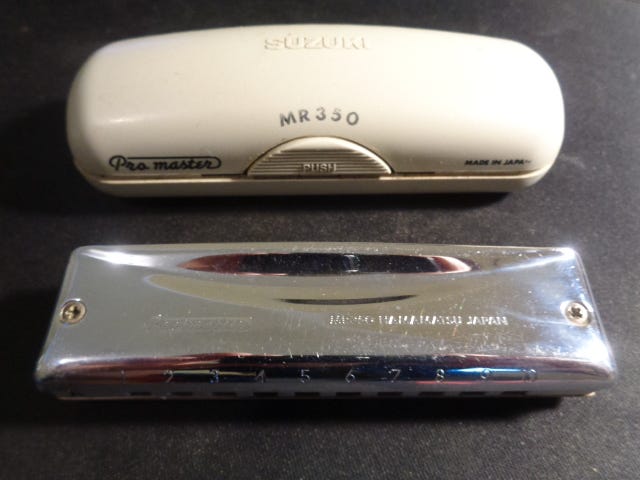
So I did have an emergency backup A harmonica, only this one was already long broken. The exact same note, hole 7 blow. But: (a) this was no ordinary harmonica; and (b) it’s my standard practice instrument, I can blow it as hard as I like without worrying about breaking it, because it’s already broken. In fact, I’ve been trying my best to break the other notes for at least 15 years without success. So I’m used to finding my way around that one missing note.
This is a Suzuki MR350. This will mean nothing to you, but the arrival of this harmonica on the scene was like driving for years on roads filled with Volkswagen Beetles and suddenly finding there’s a Porsche 911 revving at the lights. A really high-performance instrument was now available on the mass market.
I remember very clearly where I bought it, because music shops in Johannesburg are a vanishing phenomenon. I’ll give you the short history. In the vintage South African version of Monopoly, the street with the highest property values is Eloff Street in Johannesburg, with all the fanciest shops. Including, in the 1980s, Magnet Music, a vast emporium with a whole line of glittering Selmer saxophones, the Porsche 928s of the woodwinds, in display cases as you entered. I bought a gold-plated Selmer S80 alto sax there. I was astonished a few years later at the Royal Festival Hall in London to find that Ornette Coleman, my icon, played the identical version with the unique scrollwork on the bell. There wasn’t any.
Then a rival music shop opened, in the 1980s there was a roaring music scene in Johannesburg. This shop was called T.O.M.S. for “that other music shop”, so much was it in the shadow of Magnet Music. It was run by a sax player called Ekkie, we played together a few times and recorded once.
Then the whole show started coming apart. As apartheid collapsed, the downtown music scene collapsed with it. All the clubs closed. Magnet Music closed and became a truly hideous butchery. You do not want to see what goes through that door when the white refrigerated trucks deliver the offal. The last time I saw Eloff Street, in the early 2000s, it was a crime-ridden wasteland, many shops dark and shuttered, the only people on the pavement being very wary bus passengers like myself, it was still a major bus route.
So Ekkie started saying that T.O.M.S. was now “the only music shop”, and this was more or less true, except — for Sandton Music.
Sandton Centre is just the mecca of shopping in the whole of Africa. Opened in 1973, it was Dubai long before Dubai was Dubai. At that time, the gold-mining triangle centred on Johannesburg was responsible for half of Africa’s GDP. There was serious money floating around. Sandton Music had grand pianos in its showroom. I very rarely went anywhere near Sandton, but if I did, I would call in at Sandton Music just to make a sure a world with grand pianos still existed. And this was where, around 1997 I think, a salesman introduced me to the Suzuki harmonica. It was a sensation, he told me, you could bend notes breathing out as well as in.
It was very expensive and I was sceptical as to these magic properties, but it looked beautiful and I had to buy it. The case still has the remnants of the price tag, but it’s washed out now. It was a few hundred rand. I see a standard model now retails for $65, that’s about R1,000 — that’s actually insanely cheap for a Porsche.
I was playing with quite a few bands around then and was just beginning to get going on this harp, and really learning how to bend those blow notes, when — disaster struck. I bent one blow note too much. If it bends, it’s funny. If it breaks, it’s not funny. It really isn’t. I never saw another of these instruments in a shop again. Sandton Music has long closed down. T.O.M.S has just closed down, I discovered. It really seems that live music is dying in a city that used to pulsate with it. Can you imagine New York literally without one single proper music shop?
Music was an absolute central pillar of the resistance to apartheid. I remember the amazing gigs we played at the King of Clubs, a big venue in central Johannesburg. It had a very special liquor licence, called a Kruger licence, after Paul Kruger, the State President of the South African Republic until 1900, when the Boer War drove him into exile in Switzerland, where he died in 1904. Kruger had vast authority in his time. A Kruger licence allowed you to keep late hours and admit anyone you liked, no questions asked. There was only a handful of them, they were very highly prized and were almost never traded. So the King of Clubs was one of the first seriously multiracial venues in Johannesburg and there was some very powerful music there. I always liked the fact that it was an edict from the most conservative Afrikaner president that facilitated the show. Even the apartheid police would never dare act against a Kruger Licence.
All gone. Now the music mostly happens on the casino circuit. There’s a crop of young black musicians these days on TV, but all the old-timers I know are either starving or dead. Mostly the latter.
So anyway. As a memento of an entirely vanished past, I have this Suzuki harmonica. I blew the hell out of it at the St. Patrick’s gig the other night, it was great fun. It was very interesting to work with the lower notes, it’s the best way to accompany singers. I’ll talk a little more about Irish harmonica later, it’s a thing once again.
So. I’ve decided to put all my energies and all my faith into the very humble harmonica. Listening to the AI music — especially with AI voices singing — I’m struck by how they are now imitating human breathing. In fact, ChatGPT insists it has to breathe, cannot recite without breathing:
For me, breath is life, is sacred. There is something very special about the direct connection with breath. The word “conspire” means “breathe together”. I have a theory that this direct connection with breath is the key to overcoming the tsunami of AI music that is inundating the planet. And it hasn’t even really started yet. This is fully existential for true musicians.
I’m therefore preparing for a series of harmonica performances and workshops, even right here on Substack. While the AI pundits tweak their stack orchestration, I’m working on the phrasing of a draw note on a broken harmonica. And I know who’s going to win this battle of the bands. I have one and only one fear of AI, but it’s a true terror. My only fear of AI is that they will steal my lines and steal my breathing. So I’m deliberately aiming for some very rough and ready performances and recordings. Everything serves to further.
I spent 17 years walking the very dangerous streets of Johannesburg, leaving South Africa for good in 2010. I refused to drive in that town, it’s far too dangerous. If you drive fast, you have to bribe the cops. If you drive at the speed limit, people shoot guns at you. In torrential rain, everyone drives at full speed, because they know the police radar isn’t working.
I almost always had a harmonica in my jacket pocket. I didn’t play in the street, you do not wish to draw any attention to yourself on a Johannesburg street, but it’s a very useful weapon. Dogs, for example, are completely freaked out by a blast on the top range of the harmonica. They hear the very high harmonics, I’ll explain more later.
I played a few times with Rian Malan, the best journalist in South Africa, one of the best journalists in the world. He’s always dressed in black and is a man of few words. If I meet him on the street, he always asks, “Got your axe?” and I always say “Yep”.
It’s just one of the features of the harmonica, you can hide it in your hand and no one even knows you’ve got a whole orchestra there. I would be at the bar having a chat when I would be spotted and called on stage. I can think of at least half a dozen bands I played with that way. I would blow all over a couple of numbers until they chased me off and back to finish my chat. It’s a good party trick in the pub where I was born.
Just so you get some idea of the power of the Suzuki Promaster, this is Igor Flach, one of the all-time harmonica greats. He was born in East Berlin, the world might have been a different place if he’d been on the other side of The Wall. He died tragically in 2008 during heart surgery for a complex condition. Personally, I have no doubt that he literally blew his heart out, a serious warning for harmonica players. He had a small harmonica shop and championed the Suzuki range, saying that they had opened a new era in harmonica playing. As far as I can see, in this famous recording he is playing the MR350. It certainly sounds like one. It’s in the key of A. He’s playing an Arabic tune called Yalla Majnun, let’s go, you crazy bastard. It’s pretty crazy. This is what I’m aiming for, but without killing myself. It’s a very high bar to contemplate.
2. The Brotherhood of Breath
I had two formative experiences of the power of breath as a musician. The first and most significant was the one and only time I heard the great saxophonist Kippie Moeketsi playing, shortly before he died in 1983.
I started learning saxophone in 1981, rehearsing on Saturday afternoons at FUBA, the Federated Union of Black Artists. We had a jazz band directed by Allen Kwela, a legendary guitarist who did not tolerate fools. The violin teacher was Sibongile Khumalo, a good friend who later became a world-famous operatic singer.
The saxophone teacher was Matume Rachabane, younger brother of Barney Rachabane, without doubt the greatest saxophonist in the country, except that Barney was usually in Paris or New York. If you ever wanted to hear seamless bebop playing, Barney was your man, except that he also had the entire idiom of African music at his beck and call. Matume was much more experimental, doing performance pieces with an outfit called the Malopoets. He’s playing soprano sax here, a signature piece called Fire:
So I was really serious about learning African saxophone; and there was one name that just reverberated among all the sax players I met, indeed, all the black jazz men. This was Kippie Moeketsi. The short story of his life is that after furious wars with the white-run music industry, Kippie got a big break and went to London in 1961 with a musical called King Kong, about a black boxer. While he was there, he had a breakdown of some sort and was hospitalized.
The doctors decided to assess his mental state by taking him to a jazz concert, the Oscar Peterson trio and Ella Fitzgerald. Kippie was completely taken by the music. At the end, he went to get Ella’s autograph, which she was happy to give.
That bold act, however, was enough to convince the British doctors that he was mentally ill. He was given electroconvulsive therapy, shocks to the brain, to try curb his enthusiasm for music.
He returned two weeks later to South Africa, literally broken. He said his brain never connected properly with his fingers again. He did make a few memorable recordings after that, but there is almost nothing of his earlier legacy.
So when I heard in 1982 that he was going to be playing at a black school in a township to the north of Jo’burg, I had to go hear him. Also performing was a newly formed outfit called the African Jazz Pioneers, which later became world famous. They’re still going.
Kippie played with a white guy on keyboard called Steve Kuny, who had tracked him down in Soweto and was jamming with him. I later shared a house with Steve. I got into big trouble when I asked him to leave, I was desperately trying to finish a master’s degree that was already a year over time and pleaded a need for concentration. I couldn’t tell him the real reason, he endlessly played Take 5 on my piano and just never kept the rhythm, it was driving me nuts.
Nonetheless, I will always be grateful to him for facilitating that performance. It was held in a big dusty classroom with a dirt floor. Kippie played some very reflective melodies. And at one point, as a tune reached a climax, he kind of hunched up and blew a phrase ending with an extended note that seemed to come right from his belly, from his very soul. It reverberated right through me, my whole being was shaken up.
And I made a decision right then and there: I was going to pursue saxophone until I could play like that. No other single note I heard has ever affected me as strongly. To this day, 44 years later, I can hear that phrase and see that dusty scene. And remember the literal physical shock of that note.
Looking for clips of the late Barney Rachabane, I actually found one where he plays a very short note like this. It’s at exactly 1:42 in the video. He dips down and blows from his belly. Oddly enough, he’s playing with Steve Kuny. And they’re at the Radium Beer Hall, which is another pub where I was born.
I played with Rian Malan here, among other acts, and once got called on stage by a terrific reggae band called Tidal Waves, a great honour because their lead guitarist Jacob is a brilliant harmonica player in his own right.
You have to watch your step at the Radium Beer Hall, established 1929 and still going strong. U2 played there once. The irrepressible owner Manny asked Bono how he should be addressed. Bono said you can call me anything you want, you can call me “cunt” if you like. So for the whole night, Manny was loudly like, “Hey cunt, here’s your drink.”
There was one other single note played by a saxophone player that really caught my attention. And is highly relevant to my thesis that breath is the way to overcome the racket from all the robots.
This one I can date exactly, Sunday 18 July 1982. I had gone to the UK to watch the World Cup, believe it or not, which was not being broadcast in South Africa. As these things happen, I caught the end of the Falklands war as well.
The highlight of the visit, however, was the Capital Radio Jazz Festival at Knebworth House, about 50 km north of London. An old university friend who now lived in Birmingham and played saxophone drove us there.
The big drawcard for me was a set with Chico Freeman, tenor saxophonist and one of the Young Lions then shaking up jazz. I had one of his albums and was really impressed by both the technical mastery and the power of his free playing. He’s calmed down a lot these days. Here’s a clip from 2001 of him with the legendary McCoy Tyner, John Coltrane’s pianist. On 4 July 1982 I had seen a legendary reunion of McCoy with his bass player Elvin Jones at the Bracknell Jazz Festival. I was amazed to see that the crowd watching the Wimbledon final was bigger than the crowd watching this historic performance, but that’s British jazz fans for you. They missed something. It was like being hit by a hurricane. I ask any musician: do you think you could stand up and blow a note in the face of this gale?
You’ll see Chico doing some circular breathing from around 14:00:
A British friend of mine in Johannesburg had tipped me off to Chico, he had seen him live in London and thought he was terrific. But wondered if the fame wasn’t going to his head. Someone had put a tape recorder on the edge of the stage and Chico had kicked it off with a few expletives. My friend thought this was over the top. I agreed, but said that any incursion on stage was off, especially when you’re recording the guy’s product. Maybe Chico had his reasons.
So while I got as close as possible to the stage, I didn’t lean my elbows on it. There was someone else on stage I was actually watching even more closely. This was the legendary trumpeter Dizzy Gillespie, long-time collaborator with Charlie Parker.
At the time I was, like so many alto sax players, learning by heart the standard Charlie Parker bebop solos. I had the sheet music and was working from a metronome. Keeping up with the ferocious beat was always a problem, but every now and then, I found my foot tapping in half time, two beats to the bar, and everything just floated into place, instead of being a frenzied rush. Then I would lose the beat and my foot would start tapping fast again.
So this may sound stupid, but I just really wanted to see how Dizzy Gillespie tapped his foot. Someone who had stood shoulder-to-shoulder with Charlie Parker on innumerable stages and kept the beat. Dizzy is an accomplished conga player, he has really good rhythm.
But there was a problem when Dizzy started playing. No one was listening. Except me, it seemed.
The reason was that it was an unusually sunny and warm morning. If you ever go to an outdoor British music festival, you’ll know that it almost always pours with rain. Dancing in the mud is a tradition. I don’t think they could really believe it was sunny at a festival. Everyone was picnicking and pouring tea and chatting. No one seemed to be paying any attention to the stage, to the obvious disgust of Chico Freeman, who clearly thought they were being disrespectful to Dizzy.
So he caught their attention. He blew one colossal loud note, and then just kept it going, using circular breathing. It resounded on and on over the crowd. Eventually, everyone stopped talking. Eventually everyone started looking at the stage.
When he was satisfied that the crowd was now paying attention, he let Dizzy carry on. It was a very powerful display of musicianship. I think it inspired the band, because they really got cracking.
And I confirmed one thing for sure. Right the way through, Dizzy’s foot was tapping at a dizzy tempo.
So I learned a lot that morning. You can play a note on an electric keyboard and hold it indefinitely. It won’t have the same effect. When you hear a real live breath hitting you, and it just goes on and on, you feel it.
One more story to end this section. There was a wonderful South African pianist called Chris McGregor. He led big bands at the Cold Castle Jazz Festivals in the early 1960s, featuring Kippie Moeketsi. I have some of those recordings, Kippie played achingly beautiful clarinet as well as sax. Castle Lager was (and still is) a popular brand of beer. The associations of music with alcohol are very strong in South Africa.
McGregor went into exile in 1964 because of harassment of his multiracial bands. He formed an outfit in London called the Brotherhood of Breath, featuring Dudu Phukwana, who I always thought was the most powerful of all the African sax players. I once drove through the night to catch Dudu playing at a greyhound racing stadium in a neighbouring country, it was a scorching performance.
I heard Chris McGregor exactly once, in 1988 in Johannesburg. He made a visit home to see his family. There was a cultural boycott on and of course it’s the most principled musicians who abide by these things. But he was persuaded to give one performance at a friend’s house, strictly invitation only.
You can go and listen to his playing, he’s very powerful. But this time, he played so softly we could hardly hear him, even though we were sitting on the floor a few feet away. It was as though he wanted to keep the whole performance secret.
He died in 1990, a big shock and a huge loss to music. But his legacy will live forever. Here he is in Stuttgart in 1989, showing how a conductor should really lead an orchestra.
I am very, very proud to be a member of the brotherhood of breath.
3. Epiphany in Aberystwyth: “Gatemouth” Brown
Don’t worry, this is my final musical epiphany, although there are a few aftershocks. But this one was undoubtedly the greatest.
Over 1978/79, I trained as a physics teacher at King’s College, London, sponsored by the British Council. This was the famous Winter of Discontent. I found myself doing practice teaching in a north London comprehensive school where, on my first day, the kids cheerfully told me how a staff member had been tied up by students and knifed nearly to death. My school supervisor, the head of science, was punched in the chest and knocked to the ground during my first lesson. It was an utterly miserable year. To this day I don’t understand how, or most of all why, I persevered. Any sane person would have given up.
So towards the end of this experience, I jumped at the chance to get out of London and visit a friend studying librarianship at Aberystwyth University in central Wales. We had a fantastic time. A lot of culture happens in these backwaters. I saw Prunella Scales of Fawlty Towers on stage in a comedy show, she was over the top and hilarious.
And there was a poster for a show the day after: American Jazz Legends. I wasn’t into jazz at the time, I was very earnestly trying to learn classical violin. The closest I’d come to jazz was seeing Stephane Grapelli live in Johannesburg a couple of times. But I really wanted to see this show. I was getting interested in jazz.
It was held in the main hall at the university. There was a good crowd. The band got cooking, everyone played their solos. And then everything went quiet and a guy came up to the microphone and mumbled something into it, and then mumbled it again. He next produced a harmonica and hit us with the full amplified sound of the blues harp. And the band took off like a rocket, with the harmonica absolutely howling up front.
I had honestly never heard harmonica playing like this. I was completely electrified. I had no idea that such things could even happen, that a harmonica could feature front and centre like this.
By the end of that show, I had fully made my mind up. I was giving up violin. I was really struggling to survive, let alone find four or five hours a day to practise. Violin requires an appalling amount of work.
Harmonica was a real thing. There were harmonica players out there. And they could blow the house down. Forget the violin. I could play all the best bits of Beethoven’s violin concerto quite convincingly on the blues harp anyway, and it was much more expressive and much more fun. Who needs the earache, the shoulder ache, from playing violin for hours? And driving all your neighbours nuts?
For decades, I wondered who that harmonica player might have been. I searched for American Jazz Legends with as much success as you might expect.
Then one day, I saw a YouTube video in my search results — Canned Heat playing at Montreux Festival.
Now, I carry a very special candle for Canned Heat. The man I regard as truly the greatest blues harmonica player I’ve ever heard, Alan “Blind Owl” Wilson, was the heart and soul of Canned Heat until his tragic death at age 27, just weeks before Janis Joplin joined the same club.
In checking out that YouTube, I was after Canned Heat and Bear, the guy who took over harp duties when Blind Owl flew off into the night. But this video featured another harmonica player. He mumbled something into the microphone and then blew the house down. And this was an immovable Swiss audience. There was not the slightest doubt: this was the exact same guy I saw at Aber in 1979.
Clarence “Gatemouth” Brown, truly an American jazz legend, if ever there was one.
I’ve done a lot of research on Gatemouth since discovering who he was. He got his name as a kid, a teacher said there was a creak in his voice like a gate. He was from Texas and said he played “world music, Texas style”. He was very critical of the lifestyle of many blues players and didn’t classify himself as a blues man.
He’s much more famous for his guitar work, which is legendary. JJ Cale got his style from Gatemouth and he influenced many others.
But he also played violin, probably what purists would call fiddle, but he is the only person I know who can literally make the instrument talk, as at 4:45 in this video, where he gets the strings to say “Thank you, thank you very much.”
If he’d played fiddle that day in Wales, I’m certain I would have stuck with the violin. But if you’re going on a world tour, a harmonica is just the easiest instrument in the world to tuck in your pocket and go.
So take a listen to Clarence Gatemouth Brown warming up a crowd. There’s an absolutely delightful extended interview he does with some college kids, they ask such excellent questions. One asks at 27:48: what do you do when you have an unresponsive audience, when there’s no reaction to your playing? And he says, “No, I don't have them kind of crowd, never, no, that's lucky, no.”
This is proof:
I’m sure Blind Owl was looking down and smiling.
I read that Gatemouth Brown went on several tours of Europe sponsored by the U.S. State Department, probably one of the most benign things they ever did. But he has one real claim to fame: he was the only Western musician ever to make a privately organized tour of the USSR, 44 shows in 1979, the very same year I saw him. He said he had a fabulous time. He has a beautiful violin blues called Near Baku.
I can only imagine what impact he must have had on a few Russian souls, who will have never seen anything like him. I know Clarence Gatemouth Brown changed my life forever.
4. Magic Dick’s Final Secret
This is a section on breathing. In general.
You breathe in, you live; you breathe out, you die. To stop breathing for even a minute is to put yourself in existential crisis.
In my years of studying breathing, I’ve heard few interviews as interesting as this one, with the truly legendary Magic Dick, composer of Whammer Jammer, the standard of blues standards since 1971. He’s speaking after a performance in London.
He starts by saying and stresses all the way through, that after 50 years of playing the harp, he’s finally learning to play softly. To breathe the note, not “blow” the note.
Trigger warning: he uses the word “epiphany” at least twice. At 15:10 he says, “Expect a revelation every day.”
And he repeats this issue of playing softly, of really getting control of the dynamics. He stresses that people like Little Walter didn’t rely on microphones and amplifiers. First and foremost, everything lies in the acoustic sound, in the actual breath.
Play lightly, he says this is what Barbecue Bob, another legend, keeps stressing on Facebook.
When Magic Dick and Barbecue Bob concur so strongly, it’s worth paying attention.
There’s a similar perspective on breathing I get from the Russian martial art systema. They avoid deep abdomen breathing as quite harmful and stressful to the body. They do a rapid burst breathing under stress, in through the nose, out through the mouth, puffing your cheeks with resistance. You do this quite shallowly — if you’re winded and your abdomen is paralyzed, you can still do this from the top of your lungs. It is ultimate survival breathing.
If you’re about to get in a fight with someone, and he starts breathing like this, run away.
Below is the single best video I’ve seen on this method. The speaker is Major Konstantin Komarov, who I rate as the most interesting of all the systema teachers I’ve watched, and they’re all great. I’ve never seen one of them even remotely fazed by anything thrown at them from any martial art. When translating comments on his videos from Russian, I found a lot of them saying “Why are you giving away our best secrets?” — he’s the only one who gets that. The legendary Alexander Lavrov gets “drunken master” a lot. If you see how cavalierly Lavrov handles fully loaded and cocked guns, you’ll see a good example of what the Italians call sprezzatura, studied nonchalance.
In the video below, Komarov explains burst breathing, leading the participants in a short but intense exercise, and then asks them to feel their hearts. If your heart is thumping away, it means it needs more oxygen. So you need to step up your inhale.
If you’re feeling dizzy, this means you’ve taken in too much oxygen, it’s going to your head. You need to up your exhale, breathe out more air. All the time, you’re looking for balance. All the time, you’re breathing at a rate appropriate to the situation.
The whole idea is to set up a rhythm, you don’t force the air out, you act more like a balloon, which naturally collapses and expels its air. No need to squeeze it.
This notion of breathing more from the top of your lungs rather than the abdomen was reinforced by a fantastic video by a Russian physicist and mathematician called Sergey Nebaluev. I watched it twice. Unfortunately it’s been removed for breach of copyright. You can find the trailer, though, which makes this central point. Don’t force things. Don’t take in any more air than you need in your present situation.
The video was put out by Vladimir Vasiliev, one of the main people leading the revival of systema. He gave a brilliant talk on breathing on Rumble that is also now unavailable. He says that every single exercise you do is really a breathing exercise, is encapsulated within the breathing. This is true of everything you do in life.
Systema really is something else. Vasiliev also put out an exceptional video on bodyguarding, featuring Konstantin Komarov, which I watched several times before it was removed. One skill he shows is how to take down your principal, the person you’re guarding, if there’s danger like shooting. Another is stepping in a diamond around your principal, four big steps and you’ve gone completely around him.
To conclude on systema, and to show how lightly they really do operate, here’s Konstantin Komarov doing a tango with a Chinese martial artist in Hong Kong. You’ll see that whatever comes at him, Komarov yields and then uses the opponent’s own energy against him.
And to end the harmonica side of this section, this is Rachelle Plas, who I think is actually the most devastating blues harmonica player on the planet right now. Here she is playing Whammer Jammer. There are lots of versions of her doing this tune, but this one lets you feel her performance quite close up. And she ends with a sustained high note that Chico Freeman would be proud of.
Magic Dick says of this tune: every single trick in the blues book is in there. Every technique, every gimmick, including singing through the harp.
There are lots of really great harmonica players around and a surprising number of brilliant female players, but for me, Rachelle Plas has just the most impeccable phrasing, timing and articulation going. And she’s great fun. But don’t mess with her. She was on the French judo team and won a silver medal in international competition. The coach told her, you have a great future in judo, but you’ll have to give up harmonica. The rest is being written in harp history.
5. The Blue Danube Blues
I grew up in the Kingdom of Swaziland in southern Africa. There was one short stretch of tarred road in the entire country when we first arrived there in 1962. We went for many long drives on dusty roads in a Morris Minor exploring the country and neighbouring Mozambique. There was no stereo or radio in the car. The music was me, sitting in the back seat.
I first blew into a harmonica at the age of five in 1962. In 1964 the Beatles brought out Love Me Do and I discovered you could bend the notes. My first role model on harp was thus John Lennon. Right from the start, I had a facility for playing tunes on the instrument. My mother was a concert pianist and the house was filled with classics, so I would play Mozart, Eine Kleine Nachtmusiek and the bird-catcher’s song. Beethoven’s Ode to Joy and Bach’s Jesu, Joy of Man’s Desiring, it was “the Bach”. A favourite was Elizabethan Serenade by Ronald Binge, described as the most beautiful tune of the 20th century. Radio Vatican used it as a signature tune and we would listen to their relay broadcast from Ethiopia every night just to hear this melody.
I was stunned when they had a whole concert for Queen Elizabeth II’s Golden Jubilee of music that had been composed in her honour and omitted this gorgeous tune. I still play it, I have to change harps to get the whole arrangement.
Dvorjak’s New World Symphony. The Russian ballad Stenka Razin, my mother’s favourite tune (Red River Valley was my father’s). One of my production numbers at age 8 was the William Tell Overture, which is just made for harmonica, as Buddy Greene proved in a truly epic performance at Carnegie Hall. Right now, the one harmonica that’s safe for me to practise on is my E harp, I can’t afford to break another of my performance instruments. This is actually the key of the William Tell, so I’ve been playing it with the orchestra, it’s sounding good.
Since starting writing this, I’ve stopped practising on the Suzuki, I’m now terrified of breaking another note.
But maybe my best tune was the Blue Danube. It’s one of the first things I teach kids when they’re starting out on harmonica. It’s blow-blow-blow-blow-blow-blow, blow blow, blow blow, blow-blow-blow-blow-blow-blow, blow blow …. draw draw, draw-draw-draw-draw-draw, draw draw, draw draw, … etc., basically wherever you like on the instrument.
I can give 100 kids harmonicas and have them all playing the Blue Danube in two minutes.
There’s something about harmonica that is obvious but no one ever comments on. If you blow from bottom to top of the harp, you get three octaves of major arpeggio: CEGCEGCEGC. This means that in a few minutes, I can teach a kid to whip through a three-octave arpeggio much faster than Heifetz could ever manage on violin.
This is quite extraordinary, when you think about it. One of the reasons I don’t play chromatic harmonica (apart from the fact that the notes don’t bend nearly as well) is that they have a repeated C, so you lose that easy arpeggio rip. For me, it’s the essence of the harmonica.
So I am reviving my whole classical catalogue. Eine Kleine Nachtmusiek has been jazzed up into a tune I title Please Stay On The Line, Your Call is Important to Us. I now have the Blue Danube Blues, a special waltz for the ballroom dancing fans. I’m working on a full production of Ravel’s Bolero, I’m convinced I can manage most of it, dynamics and all. Parts of Carl Orff’s Carmina Burana are fantastic on harp. And there’s a blues harp version of Beethoven’s violin concerto, the best bits, still one of my favourite pieces of music. You can make an amazingly convincing transition from the high solo violin to orchestra.
You can articulate notes in ways that even Hilary Hahn can’t manage on violin and she can play Paganini while hoola-hooping. The use of the mouth to articulate notes directly, and use of the hands to literally shape a note in the air, are unique features of the harmonica. I’ll note below the “mouth bow”, the one bowed instrument you can articulate.
This classical repertoire is all just a sideline, please remember. I want you to understand how much work is involved here. There are just so many tunes, as my final witness to the magic of the harmonica will attest.
6. www.irishharmonica.com
The Suzuki harmonicas with their phosphor bronze reeds transformed harmonica playing. There is a now a very wide range of specialist harmonicas available, like Dr Schaman’s Medical Harmonica. There are XB harps for extreme bending, minor key instruments, deep bass harmonicas, you name it.
The innovation I am after is green, the new Hohner Rocket. This has been specially designed for Irish music. It’s touted as the loudest harp you can buy. And I want one. In fact, I want them all.
But there is one in particular I want, it’s a customized C Rocket. And the person who’s going to customize it for me is the Hohner “finisher” Joel Andersson, who is bringing the harp back into Irish music big time, and and we don’t mean the tinkly harp with strings.
Harmonica was huge in Ireland, a cheap instrument in a society that was very poor and very musical. There were harmonica factories. Then the accordion came along, much louder, and the harp faded, although it never disappeared. I was told by an Irish folk singer, Lee, that by law you cannot call yourself a music shop in Ireland unless you sell harmonicas. I have a harmonica medley called The Irish Music Shop. I performed a couple of times with Lee, she literally had a voice like an angel.
The Rocket that I want Joel Andersson to customize for me will have a very special tuning: C = 256 Hz. If you are mathematical, you will realise this is a power of 2, two to the power eight. It is therefore the eighth octave of 1 Hz, one second. This is actually the primal unit of time of the universe, it’s the one thing the physicists get right. I want this harmonica to be in tune with the cosmos.
The notes will also be different — they will be tuned exactly to the harmonic scale, the overtone scale, not the Western tempered scale, which is out of tune with itself, as this short video will prove to you.
This way, I will have a harmonica that is truly in tune with itself, as well as the wider universe. The microcosm contains the macrocosm, don’t you know. That’s what we’re cupping in our hands.
Joel Andersson says he’s usually booked two or three years ahead, so put in your order now and start saving.
There’s a special reason I want a harmonica tuned to the harmonics, literally. I have spent decades practising overtone singing, and the very best way to learn this art is to sing through a harmonica. Every singer should have one anyway, just to learn to sing in tune.
There’s some basic physics of waves: if you play two notes together, you hear also both the sum and the difference between their frequencies. If you play 400 Hz and 401 Hz together, you get “beat frequencies” at 801 Hz and 1 Hz. The latter is a whump-whump vibration at one cycle per second, a literal beat. The other is a high note, often too high to hear, which is what gets the dogs.
If you play the top two notes of the harmonica together, C and G, the ratio of their frequencies is 4:3. So you get beat frequencies of 7 and 1. That “1” is the C two octaves down. When you play those top notes together, you quite clearly hear that lower note sounding. It’s literally the note in between the notes, it’s the difference of the two notes.
By bending one of the notes I’m playing, I can make that “ghost” lower note go up and down. By shaping my mouth, I can resonate with that lower note and bring it out.
If you’re singing though the harmonica and you lock directly on to the frequency, so you’re singing perfectly in tune, that “whump-whump” will slow down and then disappear. You are now spot on frequency. This teaches you to hold a note perfectly without any wavering.
Once you can do this, you will find there is an entire scale of overtone notes inside that single note, which you can select with your throat. This is the basis of didgeridoo playing and the primal jaw harp.
The overtones are literally the melody contained within one note. It’s sometimes called the “intensive” melody, as opposed to the extensive melody, where each note is distinct.
It’s only the harmonica in Western music that really allows you to shape the overtones with your mouth in this way. The harmonics are also what makes those lower draw notes so expressive, you get a whole range of tones in one note. Most harmonica players engage the overtones in their draw notes without having any idea what they’re doing. Overtones and the overtone scale are the first things Magic Dick talks about.
There is actually a bowed instrument with which you can articulate harmonics. This is my friend Cara Stacey playing umrhubhe along with a conventional violin.
The physics of harmonica is deep. Many people noted in the past that you can bend holes 1 to 6 while breathing in, but holes 7 to 10, the high ones, breathing out, as Rachelle Plas demonstrates so dramatically. No one knew why, until they realized, on the first seven holes, draw is always higher than blow. So the draw note is pulled down towards the reed sitting below it.
Holes 7 to 10, blow is higher than draw, so it’s the blow note that gets pulled down. Simple as that. Each of the three octaves of the blues harp has a different arrangement of notes, only in the middle one do you get the full do-re-mi.
Joel Andersson is going out of his way to show just how versatile the solo harmonica is, how much you can achieve without special effects and electronics. This is a showcase of his virtuosity on a bass harmonica:
He says that playing Irish harmonica is just endless tunes, tunes, tunes. He has a whole list he’s continuously working on, he plays while he’s driving, every moment he’s got. Old tunes he forgot long ago are coming back. He says with Irish music it’s all in the melody, you can’t get by strumming chords. You either know the tune, in which case you jump in, or you don’t, in which case you sit out.
Endless, endless tunes. I’m trying very hard to close off here.
You may ask why I was so undercover, why I didn’t join a band. I was fighting an existential war with the ANC at the time about education. Two of my friends were blackmailed and told to spy on me. I had two direct death threats. I told people, I’m happy to jam, but I have to keep a low profile, don’t mention my name, it won’t do you any good.
I’m concluding with the ancestor of the harmonica, the jaw harp. My absolute totemic performer on this instrument is a full-on Siberian shaman called Olena Uutai. She is literally a phenomenon of nature.
I rate this as the single most dangerous instrument to play, you can shatter your teeth and shred your lips and tongue if you’re not careful. This is the best tutorial I’ve ever seen, it’s by Olena Uutai.
The jaw harp is also very important in India, where it’s called the morsing, which I love, since I learnt Morse code more or less at the same time I picked up harmonica. A story for another day.
So to truly end off, and show that I really do play the harmonica, here’s a clip from the one recording I put up on the internet, details for another day. Bonus points for anyone who can identify the band and the song. Hint: the guest guitarist who precedes me is very famous. I read a detective novel a while back, a highly rated international author, and there was one real-life person who appears in this gripping tale, it’s this very guitarist. He’s the top expert the sleuth consults on the blues and the way the music industry works. A tough act to follow.
This recording was done in zero takes. I asked them to run it through for me to warm up. They did. I said, OK, I’m ready to begin, roll it. They said you’ve finished, dude, go home.
Amazing! You need to write a book about this time in your life. Great harmonica playing at the end.