
Zionism's Perfect Weapon
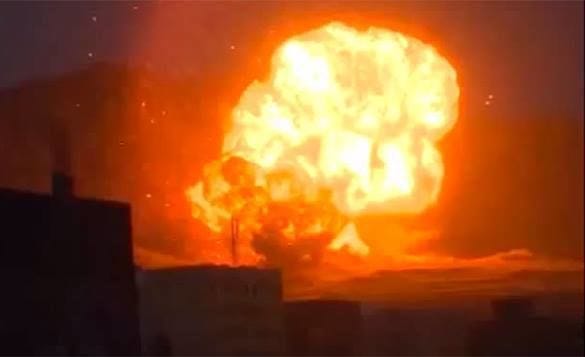
Tactical neutron bombs kill all life, but leave infrastructure relatively intact. Troops can occupy within an hour. The world remains ignorant. What could possibly be better?

1. A conversation in the Bohemian
It was my birthday and I was at my local pub, the Bohemian, in Auckland Park in Johannesburg. It was in the same suburb as the South African Broadcasting Corporation headquarters, meaning that the pub never got load-shed during the city’s endless rolling blackouts. The SABC always had power.
In the Bohemian that night, around 2005, I met someone I knew from thirty years previously, a technician in the workshop of the physics department of the University of the Witwatersrand. As a first-year student in 1974, I got a holiday job working in the low-temperature lab, which mainly entailed going to the workshop and asking them to make items like gold-plated tweezers. For the professor.
“You fuck off and tell your professor to go fuck himself,” I would be told by the workshop chief.
I did this for two years and earned a certain respect from the basement for my ability to make excuses for my presence. I was always terrified to go down there.
I returned to lecture in the Wits physics department from 1983 to 1987 and managed to keep well clear of the workshop. However, my technician friend and I recognized each other immediately that night. We started talking about the old days and what went down in the department.
Lots of memories went through my mind. My office in the basement, overlooking the internal sewer where they illegally dumped chemicals when no one was looking.
An Afrikaans professor drinking too much at a Physics Society cheese and wine, and saying belligerently, “Why shouldn’t South Africa have an atom bomb?”
Shady characters in the corridors speaking Hebrew who were never introduced to us. They notably visited the Theoretical Suite, a whole corridor that was blocked off to prevent the theoreticians from having to brush shoulders with experimentalists or (heaven forfend) educationists like myself. I was evicted to the basement sewer level in this land grab, so I remember the characters in that corridor well.
Being ordered by an acting head of department to use my class register to identify black students the police were looking for, so they could be arrested right there in the laboratories during a practical session. This was on written instructions from the Senate of the university.
Being told by the same acting head that he knew I was a “communist” and was keeping a close eye on me. He told me how he could spy on me in my office from an internal window if he stood on his toes. “I see you put your feet on your desk.”
Cutting to the chase in the Bohemian, I asked my workshop friend if he knew anything about nuclear weapons development in the department. He laughed. “We were making nuclear shells for the G6 cannon, neutron bombs. We were making parts for the G6 as well.”
I asked about electromagnetic weapons, of which there had been rumours, and he said yes, they also worked on those, mainly doing shielding.
It was a most interesting evening. As I thought back on it, other memories from the physics department returned. Resigning in 1987 in disgust after being informed that I was being spied on, I had shaken hands with the new acting head and said farewell. I told him nothing about my reasons for leaving. He was a brilliant young Dutch physicist with known strong anti-apartheid views. I clearly remember thinking that he looked like an Alpine mountaineer, he had a short beard and a rugged appearance.
I had deliberately avoided talking to him in the tearoom, because he was obviously a very good guy and I didn’t want him to get into any trouble by being associated with me, a known “communist”.
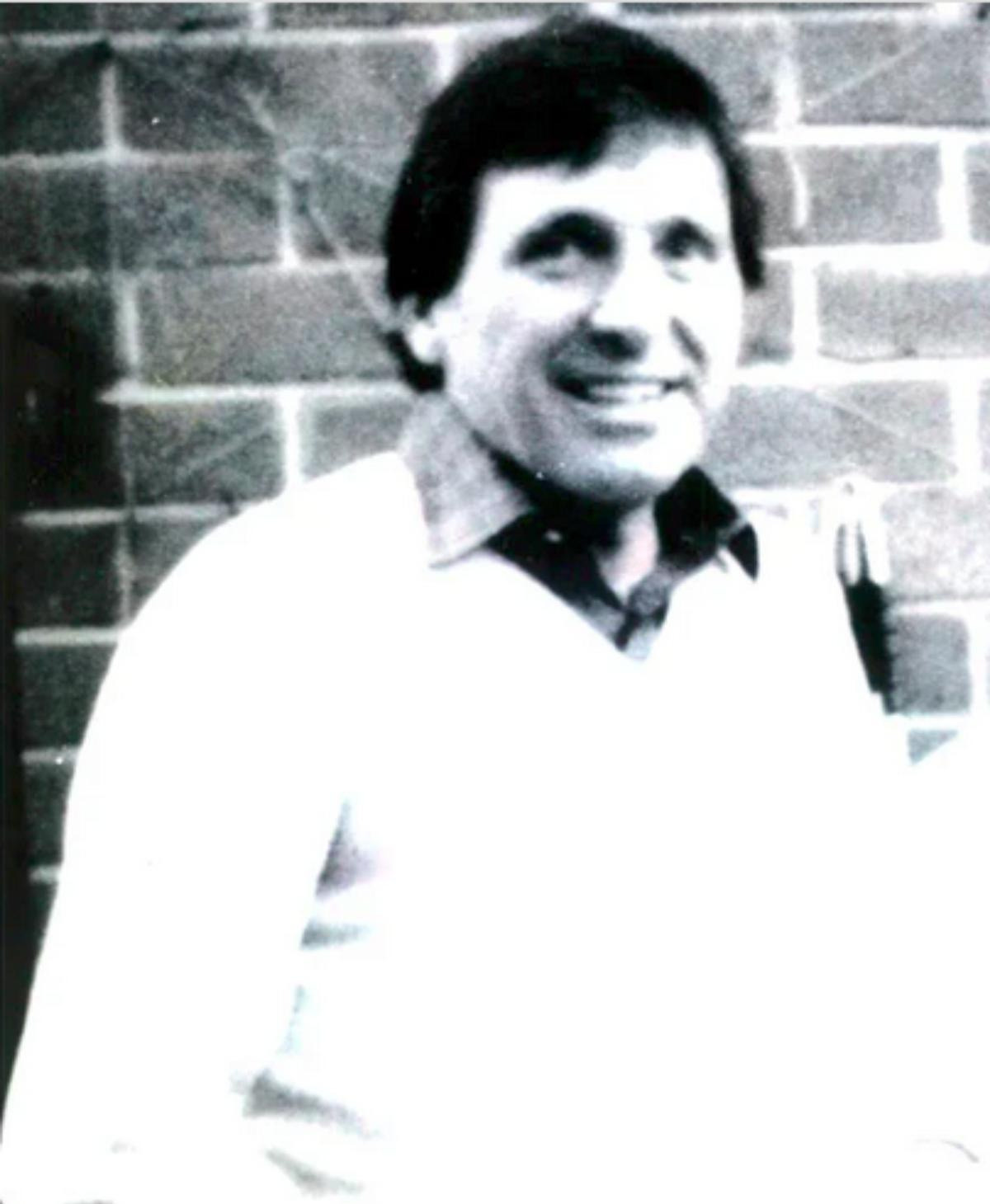
I was out of the country when this professor was found dead in the Wits swimming pool a few months later. He was said to have had a heart attack. This was the fittest guy in the department, that’s why he was all alone in the notoriously cold Wits pool that early morning.
No one ever said a word about it, but I was very suspicious about this death when I first heard the details. Years later, however, after the chat with my friend from the workshop, a certainty crystallized in my mind. This professor had been murdered. He held the Chair in Experimental Physics and was about to become full head of department. If anyone was going to find out what was going on in the basement workshop, it would have been him.
So I believe I can add one more to the long tally of people who were killed because they got too close to the secrets of the apartheid nuclear weapons programme. I have attached a book on this subject below. You can start counting the murders and so-called suicides, whole families brutally wiped out. I’m publishing this prologue to keep me alive during the writing of this article. My calculation is that the powers-that-be will not wish to draw attention to a nobody from nowhere with this on the board.
This story is unavoidably a personal odyssey. I will try to tell it as objectively as possible, but having worked right next to people who were secretly building weapons of mass destruction for the apartheid state, it’s difficult to shake off the feelings. Wits traded heavily on its liberal reputation and opposition to apartheid. The truth would be very embarrassing indeed. It has never been revealed.
One thing I know for sure. There were a lot of very clever minds behind these weapons, clever people with enormous resources. The boast of the physics department workshop was “If it can be made, we can make it.”
Whatever these people created was certainly far beyond the six primitive atom bombs that the apartheid regime declared it had built and then destroyed. These guys would only have gone for the most sophisticated and modern designs. Exactly what they developed with the help of those Hebrew-speaking visitors is the subject of this essay: an entirely new class of nuclear weapons, designed for tactical warfare even in urban settings. Pure fusion devices with virtually no radioactive fallout, a whole new physics, and more especially, a whole new chemistry.
There is scientific evidence, from soil analysis of bomb craters, that these weapons have already been used in Lebanon, Iraq and Gaza. There are also stories from Yemen during the Saudi Arabian blitz of that nation.
We will see that these weapons may well have been field-tested in Angola during the 1980s. They were certainly deployed to the battlefront, according to the consistent testimony of several special forces operators who guarded them. Without doubt, the “Vela incident” of 22 September 1979, when a satellite detected the double flash of a nuclear blast in the Indian Ocean, was a joint test between the apartheid regime and their Zionist pals.
With the looming threat of all-out war in the Middle East, especially in Lebanon and Iran, I am certain that these weapons will be used in a major way soon. The question is whether anyone on the outside will even know what is going on. These tactical nukes can be folded into conventional weapons bombardments, and in the fog of war, no one would even know what was happening.
This article is an attempt to warn the world of the terrifying reality that is coming, indeed is already here.
26 November 2025
~0~
2. Dr Strangelove For Beginners, or MAD 101
Thomas Reed and Danny Stillman, The Nuclear Express:
All the other nuclear experts with whom we have talked, however, and all the nuclear weapons laboratory directors then on duty, felt then and feel now that the event of September 1979 was a nuclear test and that U.S. intelligence was deliberately suborned then (and often since) to deliver the desired answer. As John Adams said long ago, “Facts are troublesome things.” In any event, according to Mordecai Vanunu’s 1986 revelations, Israel’s neutron bomb was in full production by 1984, five years after the 1979 event.
Mordechai Vanunu, interviewed by Amy Goodman on Democracy Now in 2004:
My revelation was Israel [had] started producing a neutron bomb. I succeed to take photograph of the model of the neutron bomb. This means Israel was ready to use nuclear weapons in the next war, in 1986 if it had war with Iraq, or Iran or Syria. It could use them against armies. That means the beginning by Israel using atomic bomb…. That was the most dangerous point in the Middle East: Israel, they could have used nuclear weapons like no other state there…
The whole point of the Doomsday Machine is lost… if you keep it a secret! Why didn’t you tell the world, eh?
The publication in 1991 of Seymour Hersh’s seminal book on the Zionist arsenal imparted two clear messages to the world: (a) the Zionist regime has nuclear weapons; and (b) they have an ultimate nuclear strategy called The Samson Option. If we go down, we’ll take you all down with us.
However, there are analysts like Zeev Maoz who believe the threat of the Samson option is exaggerated to hide the fact that the Zionist plan includes the use of tactical nuclear weapons:
The possibility that Israel possesses a wide range of tactical and strategic nuclear weapons grossly distorts the notion of the “Samson option” that the government has disseminated to the Israeli public. The regime of secrecy surrounding Israel’s nuclear policy makes this distinction possible.
How can use of tactical nukes be possible within occupied Palestine? Any use of nuclear weapons at such close quarters would surely be disastrous. Even low-yield neutron bombs use nuclear fission, a conventional atomic blast, to trigger the “clean” fusion explosion. The fission component will inevitably leave radioactive fallout. There is no known pure fusion weapon.
Yet there is evidence that some kind of neutron bomb has already been used in Gaza. Renowned forensic investigator Chris Busby said of soil samples from craters in Lebanon in 2006 and Gaza in 2008: “The absence of fission-products together with existence of short-lived radioactivity at the impact site supports the view that the weapon may be a neutron-producing device of some kind.”
In 2024, Busby published another paper extending this work, in which he concluded: “An inevitable deduction from the consistent findings of enriched Uranium in samples from Gaza, Lebanon and Iraq, is that a nuclear weapon of some kind has been employed since the second Gulf War, and possibly before then. This is an Israeli (and USA) secret weapon, as reported by Robert Fisk in the Independent in 2006.”
Fisk’s article focused especially on Lebanon and Busby’s evidence from two bomb craters there, which Fisk said “suggests that uranium-based munitions may now also be included in Israel’s weapons inventory – and were used against targets in Lebanon”.
The tactical use of nuclear weapons completely inverts the dynamic of deterrence. Instead of using the threat of nuclear weapons to deter conflict, the fact that the Zionists have this secret weapon encourages them to push for an all-out war they think they can win.
The “regime of secrecy” is thus essential to the overall strategy. By quietly encouraging the idea that the Samson option is the central logic of Zionist nuclear doctrine – drastic global deterrence – and then very secretly folding tactical nukes into conventional bombardments, the clear aim is a war of occupying annihilation. The truth of these weapons will only be revealed long after all the “Amalek” – those who resist occupation and ethnic cleansing – are dead. This is what the Zionists call “establishing facts on the ground”.
The Cold War was fought under MAD rules: Mutually Assured Destruction, if one side used nuclear weapons, the other would reply in full force and everyone would die. Even the name of this doctrine shows that it is a declared, public policy, in line with Dr Strangelove’s dictum on the use of doomsday weapons for deterrence. You tell people you’ve got them.
The Zionists have a secret within a secret. They have made a game out of pretending to keep their conventional nukes a big mystery, when everyone knows they have them. By making a fuss out of this secret, they protect the deeper secret, their tactical nuclear weapons. The South African experience will show us just how many people they are prepared to kill to preserve this deeper secret.
3. ‘No human being deserves to die in this manner’
There is only one properly researched account of the nuclear weapons collaboration between the Zionist entity and the apartheid South African regime, this being The Mini-Nuke Conspiracy: Mandela’s Nuclear Nightmare, by Peter Hounam and Steve McQuillan, published in 1995.
The introduction begins thus: “There is one inevitability about this book: its disclosures will be denied.” And so it was to be. Apart from a few sceptical reviews, this work has faded into obscurity. Yet this story it tells is compelling and crucial to an understanding of what is actually going on in the world today.
I’ve attached the text to this book at the end of this article as a PDF. It was available online as an untidy html version, which I cleaned up. There’s also a scanned version available with the images.
I will be giving the essence of its information, with extensive quotes, but anyone who wants to understand the full story absolutely has to read this book.
At one level, it begins and ends as a multiple murder mystery. A number of people in South Africa trading in chemicals meet extremely violent deaths, clearly intended to send some kind of message.
At another level, it’s an investigation across four continents into the creation of an entirely new class of nuclear weapons, teasing out the mystery especially by speaking with various anonymous informants in South Africa who were involved with the project – from scientists and project managers to special forces operators who guarded these weapons.
A Washington Post review of this book dismissed it as follows:
They deliver an overwrought yarn of hotel and restaurant rendezvous with a cast of anonymous police agents, arms dealers, “nuclear program managers” and former commandos named “Jan,” “Jake,” “Dion,” “Simon,” “Jeff,” “Rick,” “Eugene,” “Hennie,” “Paul,” “Jeff” and even, believe it or not, “The Moustache” and “Skinny” – at the end of which we are surely further from the truth than Nelson Mandela.
I can give a little perspective here. “The Moustache” and “Skinny” were two police officers who came to the journalists for help in their investigations. They were mortified to be seeking aid from such outsiders, but badly needed help in navigating the complex political landscape around these cases. The description of this interaction is entirely convincing and quite amusing – by their own admission, it was very embarrassing for the police to have to ask journalists for assistance.
One of the authors, Steve McQuillan, was reporting for the Weekend Star in Johannesburg, which later became the Saturday Star. I worked at that newspaper as senior copy editor from 2003 to 2005. I met journalists who knew McQuillan well and regarded him as one of the top experts on military affairs in the South African media.
I have met many former South African military men, including special forces operators. I found that some had severe PTSD from their experiences, and that for those who had served in Angola, it was best never to mention the United Nations, for fear of triggering a violent reaction.
You will see ten special forces informants’ names listed in that review. This is quite a tally for a normally extremely tight-lipped crew. These journalists went to every length to find people who could tell them about the nuclear weapons programme. It is amazing that they got so many participants to go on the record.
To my eye, every single interaction and interview reported looks completely authentic and credible.
The journalists travelled to Russia to undertake an extensive and very revealing investigation of the esoteric chemicals allegedly used to produce these weapons. They also undertook research in Europe and the United Kingdom. This was a heavyweight investigation. I can only stress again that this book is crucial to any understanding of the South African atom bombs and the people who helped create them.
The book begins with the brutal murder of Alan Kidger, a British chemicals trader working out of Johannesburg. His body was found in the boot of his car in Johannesburg on 9 November 1991, chopped to pieces and smeared with a chemical compound that turned out to have a high mercury content. Thieves broke into the abandoned vehicle and fled in shock when they found the body in the boot.
The journalists spoke to Lt. Col. Charles Landman, in charge of this murder case, who showed them photographs of the victim:
“Whoever did this has to be found,” Landman told us. “We’re not dealing with a normal killer here. No human being deserves to die in this manner.”
Jim Kidger, the victim’s brother, identified his mutilated body. Alan Kidger had been the international sales director at a company called Thor Chemicals, which dealt in mercury compounds. At the morgue:
…a detective was in a discussion with an executive from Thor. Jim said they were speculating about the substance smeared over his brother’s body. “The Thor chap was talking about red mercury,” said Jim, “a very expensive substance in which his company apparently had an interest at that time. From the conversation, it seemed Alan had been dealing with that aspect of the work as part of Thor’s business plan.”
This was the very first mention of “red mercury” in this case, which later became known as the “red mercury murders”, a long-running and inconclusive saga in the South African media.
It is not an accident that the authors used the word “conspiracy” in the title of their book. The term “red mercury” is inextricably linked with every kind of lurid conspiracy theory. In trying to lobby journalists and commentators to look at this story, I hit a brick wall the moment anyone found out it was about red mercury. It is a brave person who even mentions it.
Chris Busby, however, is such a person. He is completely unfazed by attacks from authorities who find his research and findings inconvenient. His 2024 paper, mentioned above, is titled: “Red Mercury? Evidence for the use by Israel of a novel uranium warhead in Palestine and Lebanon”.
Does such a substance actually exist? Can it be used to make miniature neutron bombs, the size of a baseball, that are “clean” and leave virtually no fallout?
According to Busby’s paper, “The Soviet code word for Enriched Uranium in the 1940s was ‘Red Mercury’.” Whatever this substance may be, the whole red mercury story started in the Soviet Union. But if there’s reality to this product, did the South Africans learn how to make a superior version? Was this being purchased in Johannesburg by countries like Iraq, creating fears of nuclear proliferation and leading to the serial murder by Mossad of the traders involved, as publicly alleged by the South African police?
3. The Dummy in the Nazi Uniform
The Mini-Nuke Conspiracy, p. 109.
But even more odd was her husband’s strange passion – he idolized the Third Reich. Linda Stoffberg recalled he had a prize collection of Hitler memorabilia and would strut up and down his patio wearing Nazi uniforms. She showed us one of them. “This was his prized possession. It was on a dummy, but the poor old dummy fell apart and I threw that away. It had all its badges and things which have fallen off over the years of moving around.” Hitler was his idol. “He was a neo-Nazi and believed in Hitler’s policies.”
Dirk Stoffberg was one of the apartheid regime’s main sanctions busters and dirty tricks operatives, working for fifteen years in the National Intelligence Service. He then became a freelance arms trader. He went on the record with the filmmaker Jacques Pauw in 1993, the year before he died, disclosing his dealings with Iran, Iraq and Libya, including the sale of chemical weapons.
Off camera, he revealed his secret arms deals with the Zionist military, as well as his trading in red mercury.
Of his long career in skulduggery, he admitted to Pauw that he was in charge of the assassination squad that murdered the ANC leader Dulcie September in Paris in 1988.
He gave testimony to the US Congress on the so-called October Surprise affair, when Iran allegedly delayed the release of American hostages to prejudice the 1980 election. Stoffberg was acting as a middleman to supply artillery to the Iranians in return for the hostages, so he saw the negotiations at close hand.
In 1984, Stoffberg dealt with Oliver North to supply further arms to Iran worth $320 million, with South Africa being used as the conduit. When it came to top-level dodgy arms deals, Dirk Stoffberg was your man.
He was also, without doubt, the most significant international dealer in red mercury in South Africa.
One of the most interesting parts of The Mini-Nuke Conspiracy is its description of the trading community in Johannesburg. This was the golden age of the fax machine, and these traders would communicate entirely by fax, including scrawled notes from Stoffberg in capital letters saying “what kind of fool do you take me for?” Invoices, bills of lading, customs clearances, all documents were faxed.
I met one of these old-school traders around 1997 when we were both staying in a residential hotel in Jeppe in Johannesburg. André was an interesting character, he had been a famous singer back in the day. He sang the first Afrikaans pop song they allowed on the radio, Ek Is Verlief Op Jou.
He retired from showbiz to take up international trading, spending years in the textile industry. He ran the Polish–South Africa Chamber of Commerce as a sideline, which gave him diplomatic status. He had suitcases full of faxes and other documents.
Although at first extremely reticent on the subject, when he saw that I knew about the apartheid nuclear weapons programme he opened up and talked to me at length about his experiences in trading in red mercury. He confirmed at first hand that it was a very real substance and that a South African version was being sold internationally in top secret. He was only alive because he saw the dangers and got out of the business in time.
He told me that the night before he was killed, Alan Kidger was banging at his door, saying “I’ve got some red mercury for sale, do you want it.” André said he refused even to open the door.
After he told me about his red mercury dealings, I read the The Mini-Nuke Conspiracy one more time right through and then lent him my copy. I told him not to worry, I had checked, and his name was not in it.
The next day he returned the book to me, genuinely pale. “I am in there,” he said. It turned out that André was his stage name. His real name, under which he did his trading, was Basil Schmidt.
André died in 2017. He was living alone with his memories when I knew him and I don’t think he’d have any problem with these details being revealed.
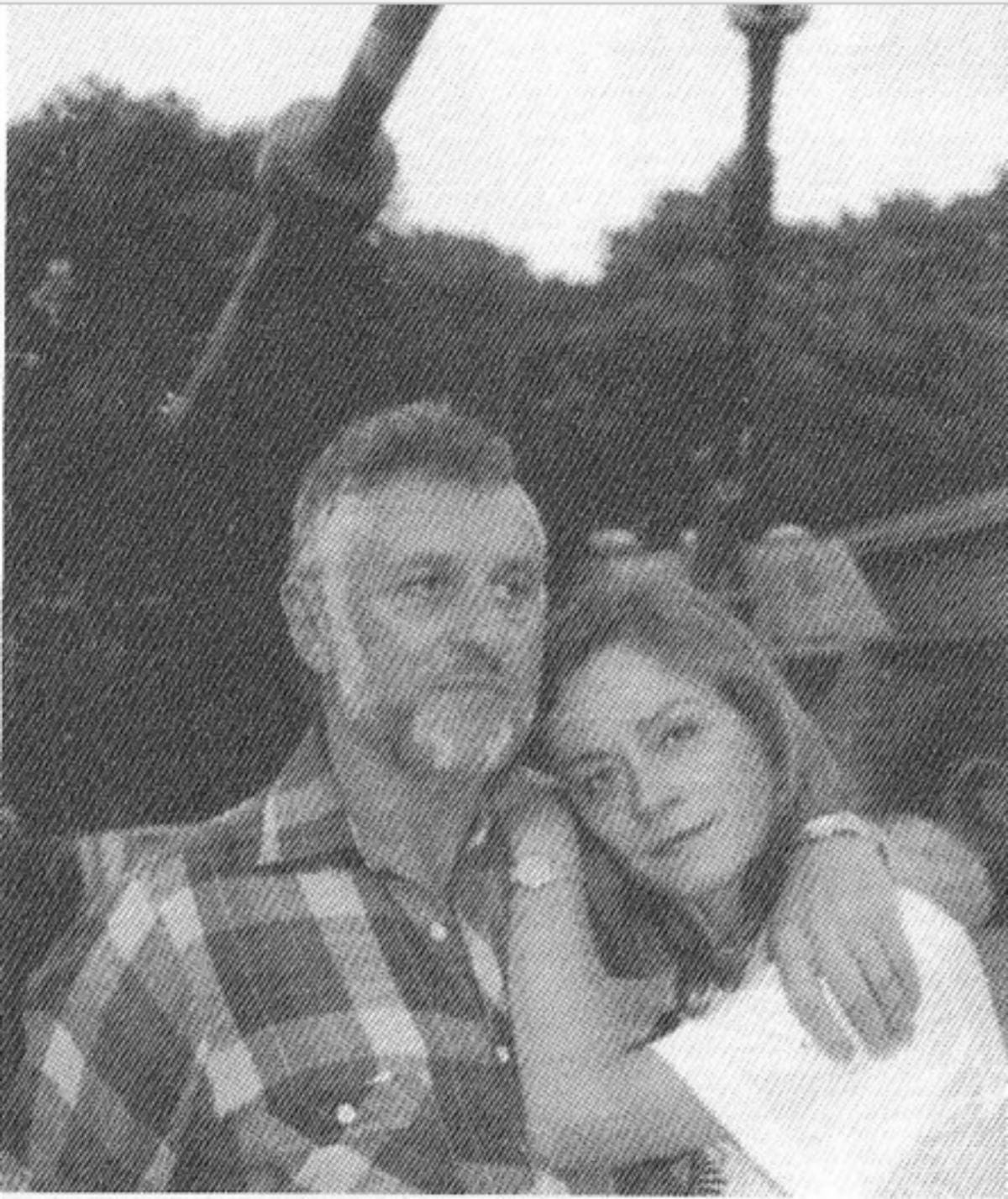
Dirk Stoffberg and his wife Suzanne were found dead in their mansion near Pretoria on 20 July 1994. She had been shot three times, he was shot once in the head. While this was all happening, someone had handled a folder with documents on red mercury, leaving bloodstains inside it, gone to the bathroom, taken toilet paper, wiped themselves clean of blood, then gone to an office and thrown the toilet paper away. There were several other bullet holes in the walls.
The investigating officer, Lt. Col. Charles Landman, said “If they were murdered, it was a very professional job to make it look like a murder/suicide.”
As soon as it transpired that Stoffberg was dead, a horde of intelligence and police agencies descended on the mansion, trying to snap up any documents they could find. On his instructions, Stoffberg’s daughter Cheryl had destroyed all the papers she could find relating to red mercury. “He said it was dangerous, and he wanted out.”
At the crime scene, a detective reported that there were a number of files laid out on a table, as if Stoffberg had been refreshing his memory of past deals. “One document related to red mercury – I don’t remember which country it was from, but there was an Indian guy called Singh and someone called Basil apparently involved in a lot of the transactions.”
This was why my friend was pale the next morning.
Reading that book didn’t make André more talkative, in fact, we rarely spoke about the subject again. But he made it clear to me that red mercury was very much for real and that the book was accurate in all important respects about the trading. He had no doubt that Mossad was involved in at least some of these murders. Stoffberg’s family thought it might have been right-wingers in South Africa who took him out. Although a gardener heard someone running in the house after the shots were fired, and a short, olive-skinned man was allegedly seen running away from the mansion, this person was never identified.
While initially saying that the incident was a murder/suicide, the police later said they were investigating the possibility that it was another killing related to red mercury.
Stoffberg had a special line in weapons trading with the Zionist regime. He had his own airline, Air Swaziland, based at Lanseria airport near Pretoria, which he used for these arms deals. He was a significant player at the top level. There is no way that such a person would have been caught up in a sustained way by the red mercury hoax, if hoax is all it was.
If red mercury is really such a big fairy tale, then why are so many people involved with it killed under the strangest circumstances? Take a careful look at The Mini-Nuke Conspiracy and tell me if you’ve ever seen a chain of murders like this, happening right across the world, targeting a particular group of traders.
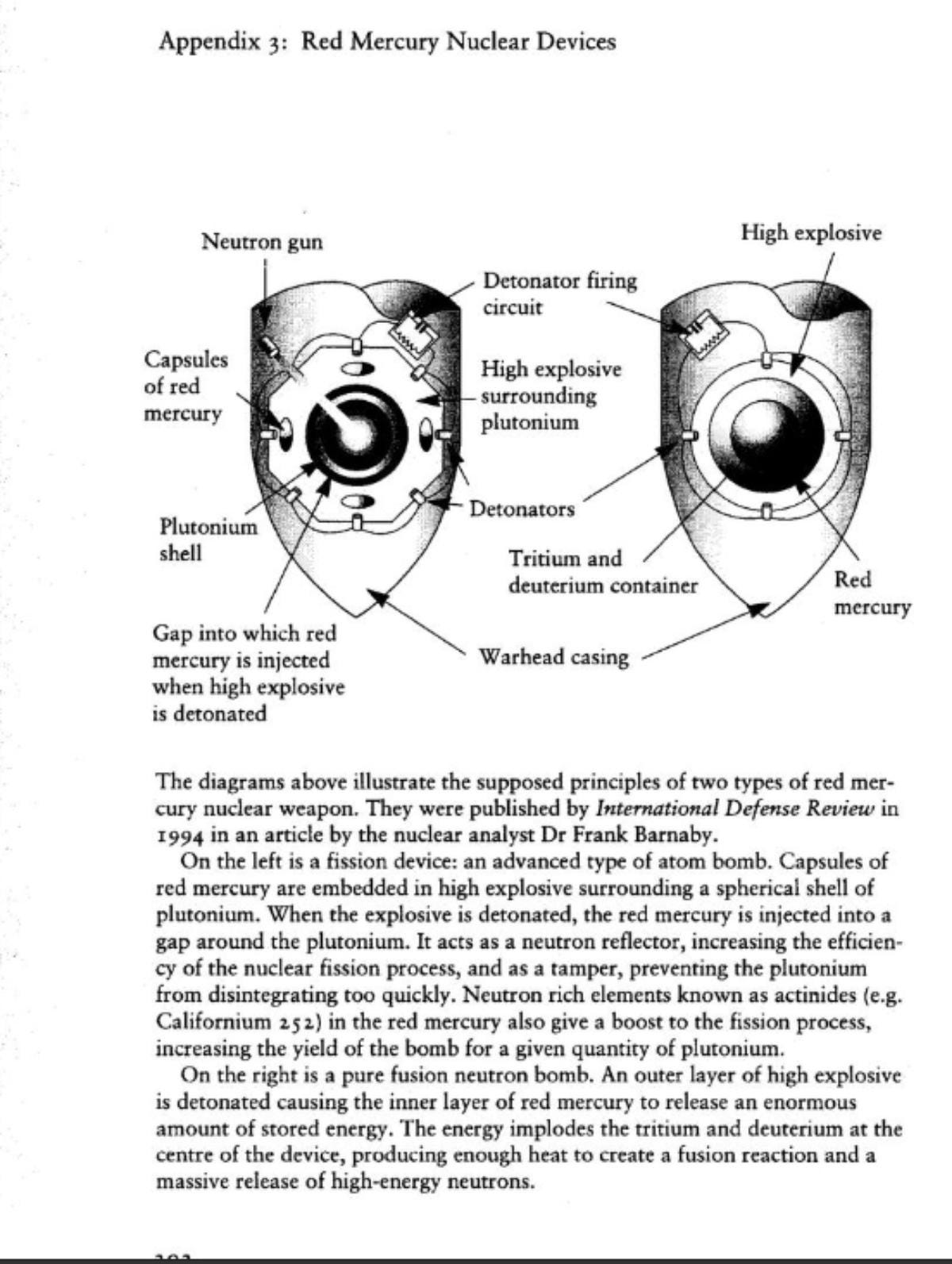
What’s so special about this mythical substance, red mercury? Why is it the key to implosion? Why does the inventor of the neutron bomb, Samuel Cohen, think the pure fusion bomb might be real? Rather than speculate, we will summarize what’s been reported of these weapons. From the fragments of evidence, we can build up a picture of the “clean” bomb.
4. Operation Shampoo – ‘Hair Today, Gone Tomorrow’
The Mini-Nuke Conspiracy, pp. 129–132. Dr Frank Barnaby, former British nuclear weapons scientist, reports after years of research into Russia’s ‘red mercury’ secret.
Barnaby reckoned that a bomb fabricated on these principles could weigh 4 kg or less. Given the high density of red mercury, the entire device might be no bigger than a grapefruit but have a yield of several kilo tons. He realized that if all this was true, the world was at the dawn of a new type of nuclear weapon – one that could give any two-bit dictator muscle.
Its technical name was innocuous enough – the “pure-fusion device” – but its properties were terrifying. Detonated in the air above a town or a battleground of tanks and artillery, it would produce a massive flux of high-energy neutrons that would penetrate all metal and concrete. Within range of the detonation, all life would be exterminated, leaving most of the buildings and vehicles intact.
The neutrons would make the area radioactive, but the radioactivity would decay within an hour or so, rendering the ground safe to occupy. (...)
There was one other expert who was even more alarmed than Barnaby. Dr Sam Cohen is now retired, but his mind is as sharp today as it was in the fifties when he worked as a nuclear weapons analyst on the Manhattan Project, the Allied nuclear weapons programme. Later he was credited with inventing the concept of more effective, and “cleaner”, neutron bomb devices. In 1993–4 he began delving into reports of new types of neutron bombs in Russia, and he reached the same conclusion as Barnaby – that there was indeed a new technology, unpublicized in the West.
Cohen even discovered that secret research was being conducted into a new class of high-energy chemicals in his own country – at the Department of Energy’s Sandia National Laboratories in New Mexico. He had heard that this research included red mercury, and the new science was dubbed “ballotechnics”.
By putting certain special chemicals under intense pressure from conventional explosives, the material could release huge amounts of energy at super-high temperatures. Cohen quoted an assessment from a classified presentation by a scientist at Sandia who said: “Under certain conditions, chemical energy density transformations obtained can be greater than with high explosives and the power exceeds that of high explosives.”
Commented Cohen: “This is exactly the principle of a small fusion bomb ignited by a substance like red mercury.”
This is the inventor of the neutron bomb, Dr Samuel Cohen, passing on classified information. Cohen is an interesting character. He felt that tactical nuclear weapons could avoid the massive civilian deaths that would occur in conventional nuclear war. He claimed that Pope John Paul II had given him a peace medal for his attempts to reform warfare.
According to Wikipedia, he proposed a nuclear “wall” to protect the Zionist entity from all attack: “What I am suggesting is the construction of a border barrier whose most effective component is an extremely intense field of nuclear radiation (produced by the operation of underground nuclear reactors), sharply confined to the barrier zone, which practically guarantees the death of anyone attempting to breach the barrier,” he wrote.
He was then called “anti-semitic” for supporting the politician Patrick Buchanan, who was critical of Zionism.
Cohen is thus a controversial individual. But when it comes to research on neutron bombs, the “clean” nuclear alternative he invented, he has to be taken seriously.
The very first mention of Operation Shampoo in The Mini-Nuke Conspiracy comes from someone called Eddie, who contacts the journalists after they started their investigation into the red mercury murders.
Eddie had claimed to be from the Israeli embassy and representative of a faction that wanted to disclose secrets about something called the “clean” bomb – a neutron device that could be detonated without any nuclear fallout. He claimed this was a bomb that was built using red mercury, and this was why people were dying. He said the weapon was linked to a secret project called Operation Shampoo.
Eddie later produces an ID card saying “Shin Beth”.
From here on, the name Operation (or Project) Shampoo recurs throughout the book, as reported by a wide range of informants, from scientists and intelligence analysts to special forces troops. For example, an apartheid arms dealer called Jake is quoted:
“This product was to be used to produce a ‘clean’ explosion: in other words, it killed people without leaving behind any radioactivity,” said Jake. He remembered people joking about the procurement programme Operation Shampoo: “‘Hair today, gone tomorrow’,” they would say.” But he said the weapon was deadly serious.
“Western countries – France, Britain, the United States and Italy – provided technical know-how and funding for the ‘clean’ bomb. They were partners in the project. They were all playing it ‘holier than thou’ about South Africa, but at the same time we were doing their dirty work for them.”
Code names can sometimes give important clues. There is no question about this with Operation Shampoo. Throughout, this project is linked to the “clean” bomb. So we can be in no doubt that there was a major enterprise carried out in South Africa to produce tactical nuclear weapons that left no radioactive footprint and could be used at close range.
Did they succeed?
I’m just going to give a few selected quotes from the book. This is from a special forces operative called Koos, who guarded nuclear materials in an underground bunker in Pretoria:
Koos said he had asked a general what he was guarding. The general said they were neutron devices, and then clammed up.
While guarding the bunker, Koos had also heard his commanding officers talk about “shampoo” but did not understand what they were referring to, except that it was linked to the small bottles.
Koos also said he had carried out a similar assignment inside a similar octagonal bunker in Angola during the Cuito Cuanavale crisis in 1988. He said: “Exactly the same material went there under exactly the same security.”
Koos appears again later in the book:
Koos said he had been told that smaller devices, similar in appearance to those he had seen, could be shot from a hand-held rocket, or even thrown as a grenade. The small but incredibly powerful devices represented “the best technology available”.
This reference to mini-nukes was backed up by Simon, another former special forces commando, who described a tiny bulb-shaped nuclear weapon that could be fired from a rifle-like device. He said he knew these devices had been tested in South Africa’s war with Angola. “We had tiny nuclear devices that could be fired from a hand-held weapon. I knew guys who had fired this thing. The shell had radioactive markings on it and was about the size of a mortar round – it looked like a beer bottle.
“When they fired one, they had to wear a special suit, to protect them from the blast effects, I guess. I was told the device could be fired about half a kilometre. They were stored in octagonal chambers in the operational area. Everyone knew they were nuclear weapons.”
Simon, who had participated in a number of covert operations inside Angola over many years, said four specially camouflaged octagonal-shaped containers had been delivered to the South African military base of Chitado in southern Angola in late 1987 or 1988 –probably airlifted by a Super Frelon helicopter. (...)
He said in 1985/6 special forces commandos had tested a “strim grenade”, which had a high-explosive warhead. “You screwed this thing on the end of an R1 [automatic rifle] and fastened a strap tightly around your arms and waist. I later heard that these same techniques were used to fire the nuclear grenades. The guys who fired these devices had to wear special glasses, and the top parts of their body had to be protected. I knew some of the guys who had fired it. There was no doubt it was nuclear. Even the viewfinders of the new weapons were different to conventional stuff.”
Paul, who had close links to Military Intelligence, said he had heard of such devices and confirmed that they had been tested near the Namibia/Angola border. He too confirmed the existence of such octagonal-shaped storage bunkers and that soldiers had to wear special protective clothing.
“There was no nuclear fallout. These tests occurred in Military Section 10, which is 15 km across the river inside Angola, near Ruacana Falls. There was no threat of radiation. A number of nuclear weapons were tested in Namibia/Angola from June 1988 to December 1988.” He said both South African and the Cuban/Russian forces in Angola had used small neutron bombs or mini-nukes in the conflict. Since then, there have been a number of unconfirmed reports of Angolan troops dying of mysterious ailments.
Laurie, a source close to foreign intelligence operations, said Angola had for years been used as an arena in which new weapons could be tested: “South Africa did have grenades that could be fired from hand-held weapons, and they were used in Angola. The Cubans too were using small tactical devices. Some of the people there are dying like flies. Doctors would find strontium in their throats.” One official South African source would later tell us: “We produced the best nuclear weapons in the world.”
One more quote, from a security source:
“The way people spoke of this, it was clear South Africa had it. Everyone knew pieces of the story and could put it all together, but no one spoke about it openly. They called it ‘Die Dingetjie’ [the little thingy]. I knew it was a red mercury device and that it was a ‘clean’ bomb – I was told people could walk back into the blast zone five minutes after detonation.”
The authors maintain that it would have been impossible for this wide range of sources from different environments, contacted in different ways, to fabricate such a consistent story. The emphasis throughout is on a “clean” weapon that can be used at close range, followed by almost immediate occupation of territory.
The other repeated emphasis is that South Africa developed its own version of red mercury, superior to the Russian product in at least one crucial respect. The Russian product would degrade very rapidly in the field and would require “refreshing” after a few months. The South African product consisted of two chemicals that were individually stable and could be stored for long periods. They would only be combined to form the active weapon in the field.
A former intelligence agent called Eugene was shown South African red mercury by his friend Dirk Stoffberg:
“Stoffberg said when the two substances were combined it would be effective for only a short period – just days. He said this was a revolutionary weapon that could destroy the people of Pretoria but leave the buildings standing. He took off the lid from the large canister and poured a little bit into a glass standing next to it. It was a purple or dark-red thick substance, which was slow-moving. He asked if we knew what it was. “Red mercury,” he said. I laughed. It was the first time I had seen the stuff.
Eugene later saw the identical material being manufactured and stored at Advena, a top-secret weapons laboratory near Pretoria. This was when he realized that everything Stoffberg had been telling him was true.
Stoffberg claimed that he was the only agent officially authorized to sell the South African product internationally and had been doing so for years.
Was he selling to Iraq? We know from the book that there was extensive arms trading between the two countries, for example that American-made proximity fuses supplied to the South Africans ended up in 155-mm artillery shells used by the Iraqis against US forces.
If South African traders were selling the chemicals to make nuclear weapons to countries like Iraq, along with the missiles and artillery to deliver them, then it would not be in the least surprising to find that Mossad had terminated these traders with extreme prejudice.
Other informants insisted that the Iraqis had their own very dangerous hit man in South Africa and it seems the authors of The Mini-Nuke Conspiracy may have had a close encounter with him in Namibia, while trying to witness a live sale of red mercury. Whatever the truth, there is no doubt that dealing privately in red mercury is a lethally dangerous undertaking anywhere in the world.
5. The Right-Wing Plot Thickens
The bottom line of The Mini-Nuke Conspiracy: Mandela’s Nuclear Nightmare is that at the end of apartheid with the first democratic elections in 1994, right-wingers in the armed forces stole and hid a number of nuclear weapons, including missiles, nuclear shells, mobile G6 cannons to fire them, and even a Buccaneer bomber that could be used to make intercontinental strikes. This was along with huge troves of conventional weapons.
The informants to the bomb programme also insisted that the South Africans had created strategic thermonuclear devices that could be used worldwide in their own version of the Samson Option. At least one of these hydrogen bombs was alleged to have fallen into right-wing hands.
No nuclear holocaust has emerged in the region. However, South Africa remains extremely unstable and violent, and the threat of an attempted coup cannot be discounted. We have President Trump talking loudly about a “genocide” of white people in that country, the strongest such rhetoric we have ever heard in international politics. In this kind of climate, do not imagine that the South African right wing is incapable of unleashing a holocaust. I am personally convinced that the threat is real and that “Mandela’s nuclear nightmare” could yet explode across the continent at any time.
I made reference to Dirk Stoffberg’s fascination with Hitler to underline that the South African bomb was largely created by hardline right wingers, some of whom were outright Nazis. These were the people the Zionists collaborated with to make weapons of mass destruction.
The single person who probably did the most to drive the South African bomb was Dr Wally Grant, chief engineer and then Director General of the Atomic Energy Board. He designed the “vortex” uranium enrichment system used and oversaw the nuclear reactors that were secretly employed to create the bombs. He would have had complete access to every facet of the weapons programme.
Wally Grant was also an avowed right-winger who was a member of various political organizations striving for an Afrikaner homeland. He was a member of the Volkstaat Council, set up by the apartheid government at the end of its rule in 1994. Its goal was to examine constitutional mechanisms that could legally create such a homeland or Volkstaat.
He was also a leading member of the Afrikaner Volksfront (AVF), an umbrella right-wing organization that eventually split when one faction led by General Constand Viljoen decided to participate in the democratic elections, while hardliners and extremists were looking for violent confrontation. Wally Grant chaired many of the meetings that led to the creation of the AVF and was a major driver of this movement.
Many of the Americans and other foreigners who worked with the South African nuclear programme were also right-wingers or apartheid fellow travellers. The Mini-Nuke Conspiracy has the following:
In 1971 Dr Sverre Kongelbeck, described as one of the best nuclear missile scientists in the United States and developer of the world’s first fully automated missile launcher, retired as chief engineer of the US Navy’s main missile laboratory and was hired by South Africa. He told the local press: “I believe I could help in the field of missiles, radar and satellites ... It is God’s own country. I’m not bothered about the racial situation.”
These people were all also fighting an apocalyptic war against godless Communism, with Angola as one of the hottest spots in the Cold War. Leopold Scholtz wrote the first academic study of the Angolan conflict, The SADF in the Border War 1966–1989. Interestingly, he reveals that Fidel Castro was “terrified” that the South Africans would use nuclear weapons. Castro was closely personally involved in directing military strategy during the war. The Cubans were extremely cautious in Angola, avoiding head-on confrontations with the SADF and employing standoff tactics with rockets and long-range artillery.
It is clear that many other nations were involved in the creation of this new class of weapons. Special efforts – including multiple murders – were evidently made to ensure that terrorists or rogue nations did not get their hands on these mini-nukes.
Meanwhile, to this day in the media, scorn and derision is poured on any mention of red mercury as a thoroughly debunked hoax.
In all of this, it’s worth noting that one prominent South African politician mentioned red mercury in a positive light. Foreign Minister Pik Botha, in a speech he gave at a nuclear energy conference in a hotel near Johannesburg in 1995, said: “If we are to ban nuclear power because of radioactivity, perhaps we could turn to red mercury. At present there is a lively debate in South Africa on this subject. Perhaps you can assist us in ascertaining whether red mercury is a hoax or a hope – to convert into fuel for electric power stations.”
Botha’s press aides said later that this was “a joke”. However, the fact is that red mercury might indeed prove to be the key to fusion energy, that dream of limitless power that is always twenty years away. Botha was not the first politician to raise this possibility – various Russian lawmakers have said that this secret should be revealed to the world, so that its positive benefits can be realized. He was probably the first in the West to do so.
The legendary water engineer Viktor Schauberger famously warned Adolf Hitler that he was going to destroy Germany because of his reliance on “explosive” technology, like the internal combustion engine. He was insistent that there was “implosive” energy in nature, particularly in water, that could provide limitless power if harnessed correctly, without pollution or other harmful side effects.
For large-scale power production, if you had to choose between nuclear fission – a highly explosive process, in which heavy atoms are shattered into radioactive fragments – and nuclear fusion, an implosive process in which light atoms fuse together to release energy with no fallout, there is actually no choice. Fusion is clearly the way. Once a fusion torch has been ignited, you can literally feed garbage into it and it will produce power forever.
The possibility of limitless energy like this will bring other formidable political opponents into play, like the oil industry. A proper investigation of the possibility of implosive nuclear power via red mercury needs to be made. It could genuinely be the solution to all the energy problems of the world. Is humanity ready for limitless, pollution-free energy? Solar and wind power are proving unable to provide reliable energy to scale. By cracking open the mystery of red mercury and nuclear fusion, we might see a way to this mythical future, but it will require a complete realignment of global politics to get there.
6. Enter the Vortex
To conclude, I want to return to the University of the Witwatersrand and some of my own experiences there.
I truly do not wish to distress anyone who knew the late Prof Berend Kolk, the brilliant experimental physicist found dead in the Wits pool in 1987, by suggesting that he was murdered. One of the reasons I mention the incident is because I am aware of the extremely suspicious deaths of two other professors at that university, both of whom I knew. If Wits pushes back at me, I have more than enough material to push back at them – enough in one case to start an immediate murder inquiry.
However, there was another professor I knew well at Wits whose name appears in The Mini-Nuke Conspiracy as a possible victim of the nuclear programme. This was David Webster, who was assassinated in the street with a shotgun blast in May 1989.
David was a social anthropologist and a great fan of African music, so we always saw him at gigs. He was doing research on communities in northern KwaZulu-Natal. I met him on the street outside Wits a few weeks before he died. We had a short chat about his work in KZN. He said they were clearing out whole communities in the area in order to make way for game parks. He added that they were using the rhetoric of animal conservation and protection of wildlife to motivate this forced removal. He said the humans they were driving out seemed to have no rights at all. It’s a conversation I will never forget, I was devastated when David was murdered.
The Mini-Nuke Conspiracy, p. 173:
Hennie, a military agent, said Northern Natal was so sensitive that a Russian helicopter which took off in Mozambique was shot down by South African security forces while it was snooping near the missile launch sites. He said he had also heard that David Webster, a Johannesburg anthropologist, was murdered because he saw too much while on field trips near the range. “I was led to believe he was killed because he saw a nuclear device that was about to be fired, but he was also killed because he had a connection with a foreign government.”
Other sources reported seeing brilliant flashes off that coast that turned night into day. There were at least three major nuclear tests in the Indian Ocean, one of which was captured by the Vela satellite in 1979. A hallmark of all these tests is that there was no radioactive signature of a nuclear blast.
There’s one other professor at Wits whose story is worth telling. This is Friedel Sellschop, who held the first chair in nuclear physics in the country when he founded and became head of Wits’s Nuclear Physics Research Unit in 1956.
The NPRU received significant funding from the Atomic Energy Board and other sources, which enabled it to become independent of the main physics department. This was headed by Prof Frank Nabarro, a British physicist whose fame lay in the study of atomic lattices. This work became crucial as the jet age started and the first commercial passenger jet aircraft, the De Havilland Comet, was involved in a number of fatal crashes.
It turned out that the square windows of the plane were causing stresses to build up in the fuselage, which then weakened, suffering what was called metal fatigue. Understanding how to make robust metal lattices suddenly became a crucial issue. This is “solid state” physics.
However, by the time I was studying at Wits in 1974, it was not a hot topic any more. Nuclear physics was where the money was. There was an open and bitter rivalry between Nabarro and Sellschop that everyone knew about. There were very few physics graduates – in my first year, there was only one student in final year – so there was sustained competition between the department and the unit for graduate students.
With money for bursaries and research available, nuclear physics was definitely the sexier field. I personally heard Sellschop derisively referring to “stolid state” physics. This perception was perhaps not helped by Nabarro’s published magnum opus being a monograph called The Physics of Creep.
Sellschop was of German heritage from Namibia, or South West Africa as it was at the time, a former German colony. I never heard this myself, but Nabarro (who was Jewish) apparently openly referred to Sellschop as a Nazi in front of other students.
I never heard anything about Sellschop’s broader politics. His obsessive lifelong concern was research in nuclear physics.
However, if you look at his career, he was deeply involved in all the processes that led to the creation of the known South African atom bombs. I am personally certain that he knew all about the nuclear weapons programme.
He helped design and operate the “vortex” uranium enrichment system that powered the first nuclear reactors in the country and ultimately produced the declared atom bombs.
He later became Deputy Vice Chancellor for Research at the university, putting him in charge of all research issues. This was now in the democratic South Africa. I wonder if the people making this appointment were aware of his connections with the apartheid atom bomb.
There’s an interesting moment in the early part of The Mini-Nuke Controversy. The first hint of a right-wing bomb comes from the police officer called “The Moustache”:
The Moustache said a few days earlier he had received a 2 a.m. telephone call from a scientist who had been one of his paid informants years earlier: “We got rid of the guy because we no longer needed him.” The man, who had worked on South Africa’s nuclear weapons programme, had not been seen by the intelligence agents since. “He was in a state,” said The Moustache. “He said he had just heard something terrible. He told me an extreme right-wing organization had got a nuclear bomb, the size and shape of a baseball bat. Then he started to cry.
“He said it was hidden in the northern Cape and urged me to find out as much as possible about red mercury. He stressed I should do it urgently. Then he said: ‘Read Vortex – it’s all in there!’ I didn’t know what he was talking about.”
Vortex was a novel by Larry Bond and Patrick Larkin, published in 1991. It was set in the near future in South Africa and foresaw a complete collapse into civil war in the country. The Cubans, sensing an opportunity, invade and head for Johannesburg. The South Africans respond with nuclear weapons, killing 3,000 Cuban and Libyan troops.
I can’t help wondering if the name “Vortex” was not a subtle reference to the uranium enrichment method that made the whole atom bomb project viable. I wonder also if we will ever know what those scientists were really getting up to at all the South African universities that were secretly making weapons of mass destruction.
I actually raised this at the Truth and Reconciliation Commission. I made a written submission saying that a public hearing should be held into universities’ participation in apartheid. Apparently I was the only person who made any kind of submission about apartheid in the education system. It was completely ignored.
I personally had one other brush with the nuclear programme in my studies. I changed from doing honours in physics to applied mathematics, after Nabarro had been extremely rude to me in class one day (he was an exceptionally caustic person in general).
I was not excited by any of the research that was going on in the physics department. What caught my eye was a very specialized module among the applied maths options. It was called RQEMHD, standing for “relativistic quantum electromagnetohydrodynamics”. This was plasma physics, the study of the fourth state of matter, superheated ionized gases.
My interest was in geophysics and the ionosphere, with which I had become fascinated as a shortwave listener and then a licensed radio ham. I was active using Morse code on the Wits amateur radio station ZS6WRC, standing for the Wits Radio Club. I managed to secure a new transceiver for the club from the treasurer of the Student Representative Council, a chubby and cheerful fellow called Craig Williamson, who later turned out to be a major spy. He voted us the money in the last drunken session of the outgoing SRC of 1974.
I was told that there was a hole in the SRC budget that was rolled over from year to year for a decade, caused by our Yaesu transceiver. This was an early example of Williamson’s financial skulduggery, for which he later became famous.
Anyway, on the day Nabarro insulted me, I went straight to the head of the applied mathematics department, Prof Tony Starfield, saying that I wanted to switch to his honours course. I was regarded as a bright student, so he was delighted to poach me from physics. I made it abundantly clear that my main reason was to do RQEMHD and that I saw this as my future in academia.
Nabarro used to hold a dinner evening at the end of the year for all the students majoring in physics, to meet with our external examiner. These visits to his house in Auckland Park (near the Bohemian, which at that stage was the home pub of the notorious Brixton police station, from where Lt. Col. Charles Landman would later undertake the red mercury murder investigations) were quite intimidating for us junior students.
The external examiner in physics was a Prof Gledhill from Rhodes University, whose speciality was the South Atlantic Anomaly, a peculiar magnetic zone between South Africa and South America.
I was the only student who knew anything about this anomaly, because as a radio man, I could instantly tell when signals were passing through this patch – they had a peculiar warble, known as “auroral flutter”. Signals from New Zealand always had it.
So Nabarro made me sit next to Gledhill at these dinners and talk to him about geophysics. It was stressful, but ultimately very interesting. Right from the start, I was genuine in my desire to understand the charged layers of plasma that surround our planet. There is a reason my Substack banner features auroras.
At the beginning of 1977, I went to the first RQEMHD class. We were there to be given the handwritten notes for the course, a thick photocopied folder. I remember seeing the familiar Navier-Stokes equations for fluid flow on the first page, and having the strong feeling, I’m going to understand this stuff. I was very excited. I hardly took note of the other students in the class – there must have been at least a dozen, but no one that I recognized.
This was unusual in itself. Although applied maths was a large department, the whole university was about 10,000 students at the time, it was quite a cozy place.
Shortly after this, I was called to Tony Starfield’s office. I had no idea why. His expression was grim. I was firmly told that I could not do RQEMHD, I was doing “too much physics” and they could not allow the applied maths department to become a surrogate for physics honours. I was stunned. I told him I was only doing two other physics-type modules, one in general relativity and another in axiomatic quantum theory. Both were prerequisites for RQEMHD.
I reminded him that the only reason I had changed to his department was to do this course, I had told him this very specifically.
At this point, he lost his temper, his face went bright red, and he screamed at me, “YOU ARE NOT DOING THIS COURSE!”
I was even ordered to hand back the notes I got. I was devastated by this and for years wondered what had happened. The answer was obvious, in retrospect. I never saw any of those other students in RQEMHD again, they were very insular. Plasma physics is essential to understanding what happens when an atom bomb goes off, particularly a thermonuclear weapon.
I had blundered straight into the heart of the nuclear weapons programme. I am certain that most of the other students on that course were on the fast track to building hydrogen bombs. With both my parents banned and listed Communists, there was no way they were letting me get anywhere near that class.
I tell this story to show just how pervasive, and how hidden, the nuclear weapons programme was in South Africa. It must have cost untold billions altogether. What could have been done with that money, if it had been invested in the future of the country instead of its potential obliteration, can hardly be imagined.
In all my research, I have found exactly one person who seemed to understand the reality of “enhanced radiation weapons”, this being a forum commentator. I’m therefore going to close with a few quotes from “blastfromthepast”, posting on a forum called Our Finite World in June 2024, who claims he got all his information from open sources.
blastfromthepast:
Israel is going to use their enhanced radiation weapons to wipe out Hezbollah very soon. They will be used semi covertly amongst conventional weapons with tight kill zones that they immediately occupy. Expand up to the next river. Hezbollah is dug in. There is no other capability that will remove Hezbollah. (…)
An enhanced radiation weapon blast is the same as a conventional explosive bomb. There is no fallout. Residual radiation is tiny. No one is going to say nothing. Where’s the proof? Conspiracy nuts. But Hezbollah gonna fall down go boom. They come out to fight, they get hit again. They will use dozens. There’s not going to be any reporters. Hezbollah will still put up a fight but you can’t beat neutron bombs. (...)
Regardless, neutron bombs or enhanced radiation weapons were natural products of Israel’s nuclear weapons programs because they were so close [technologically]. Enhanced radiation weapons have very little of the blast of thermonuclear weapons. They kill by the wave of neutron radiation they emit and this can be controlled with great accuracy. The small kill zone can be determined. This has many advantages. Friendly troops can be close to occupied areas where neutron bombs were deployed. There is no fallout, just the initial killing wave of neutrons. Neutron bombs are single stage, easier to make than thermonuclear, using only Uranium.
Are other people talking about this? No. It’s a curious thing. You can find out about most of Israel’s nuclear weapons on Wikipedia. No one talks about it.
This is exactly the scenario that I envisage. I believe it is being played out right now. There are a couple of points I want to amplify. “There’s not going to be any reporters.” This is crucial; the fog of war is an essential element of the strategy. And: “No one talks about it.” The cone of silence around this subject is absolute.
There’s a big claim in The Mini-Nuke Conspiracy. They say that red mercury may be the biggest secret in the world. If it is indeed the key to fusion energy, this assessment is quite valid.
The giveaway to its use in warfare is going to be monitoring the kinds of casualties that occur. Nuclear radiation victims often do not die immediately. Even after massive and fatal doses of radiation, victims can appear relatively normal for a couple of days before they succumb. As in Angola, reports of strange illnesses and deaths need to be followed closely if we are to find out what is going on.
There is much more to this story, but we will end here. In the next year or so, it may be time for an update. I pray that this will not be a mortality analysis.
Postscript: For anyone irritated by my use of “the Zionist entity” for occupied Palestine, I do apologize, because it’s an ugly term. But we are talking about an ugly reality. For the record, I spent seven months in Jerusalem in 1987 after resigning from Wits university. I went with an open mind and left in horror at the occupation. I met with Palestinian students in one of their West Bank villages, mostly members of a theatre group, and what they told me of their oppression reminded me very strongly of Soweto in 1976. I told this to several of the Zionists I met. I said there was going to be an explosion there, led by Palestinian youth. I was informed firmly that “You foreigners don’t understand, we have the Arabs under control.”
I left at the end of November 1987. Within a couple of weeks of my departure, the first intifada erupted. The Zionist security establishment was caught totally by surprise. Like the South African army in Soweto, they were completely unprepared to deal with children throwing stones.
I also met conservative Jewish religious students who were emphatically anti-Zionist, who told me firmly that Zionism was a far worse evil than Nazism. I am excluding people like this from the label “Zionist”. There are many American Christians who are staunch Zionists, but are not citizens of occupied Palestine. They are also excluded here, because I’m strictly talking about the rogue state and its zealous citizens, not its supporters outside, who often have no clue what is really happening with the occupation.
If you look at the Balfour Declaration, which laid the foundations for the Zionist entity, it says: “...it being clearly understood that nothing shall be done which may prejudice the civil and religious rights of existing non-Jewish communities in Palestine.” The sustained and vicious ethnic cleansing that has occurred since 1948 renders the Balfour Declaration null and void, even if the British ever had a right to give Palestine away in the first place. I feel very strongly that there is only one possible solution for Palestine: the one-state solution. As with the Golden Era of Judaic studies under Muslim rule in Spain, I honestly think that the Jews of Palestine, the ones who stay, will find amazing tolerance in the Holy Land in the long run.
If I am to use the “I” word, it will be to commemorate the victim of the first Zionist political assassination in Palestine, Jacob Israël de Haan. Originally from Holland, he moved to Jerusalem and became aware of the evils of Zionism. According to Wikipedia, Rabbi Yosef Chaim Sonnenfeld chose De Haan to organize and represent the Haredi (orthodox) position as their foreign minister. De Haan made plans to travel to London in July 1924 with a Haredi delegation to argue against the Zionist takeover of Palestine.
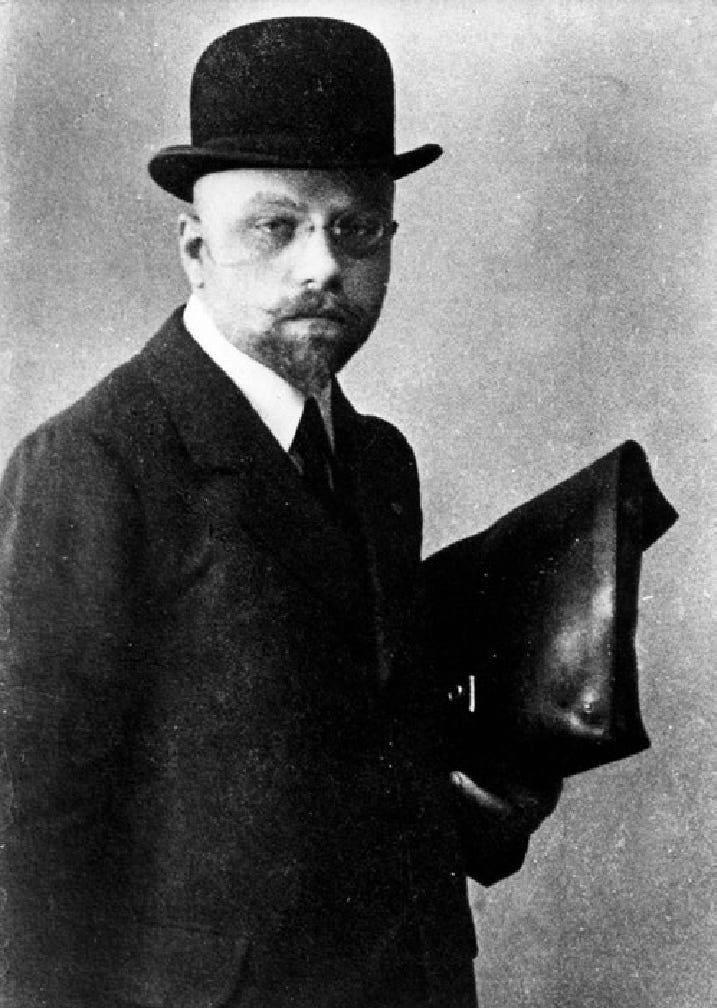
Before he could leave for London, Jacob Israël de Haan was assassinated in Jerusalem on 30 June 1924 by Avraham Tehomi, a member of the paramilitary Haganah organization. The appalling assassinations continue to this day.
1 December 2025
---
