
h = 1: The Time-Reversed Wave
Quantum biology and the origins of species.

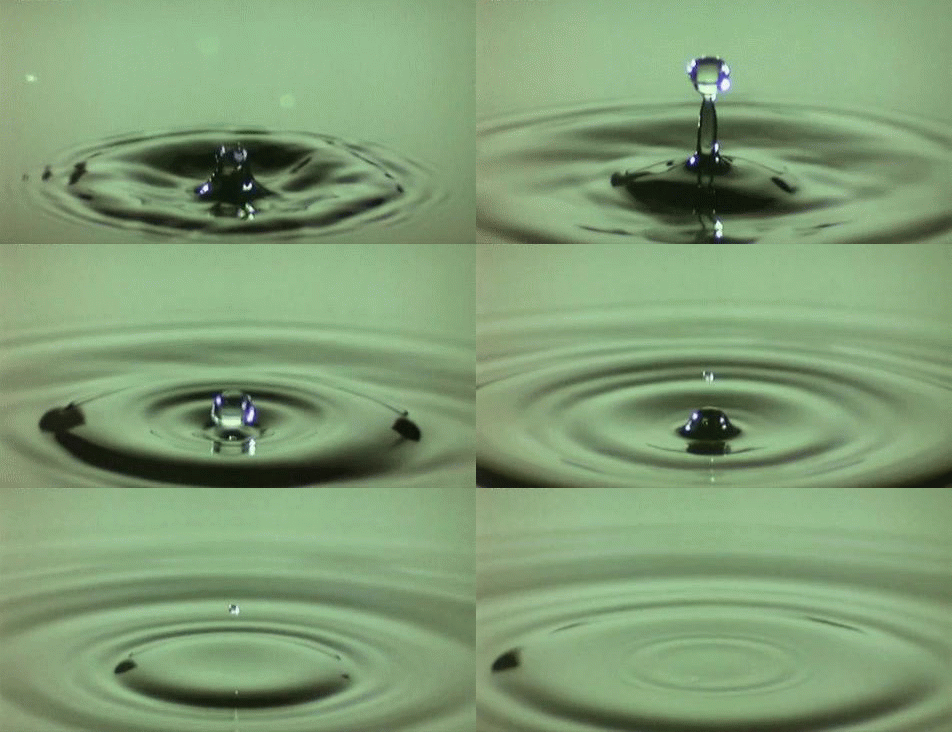
Continued from “h = 1: Quantum Consciousness”
4. Those Magical Disappearing Secondary Wavelets
I still have my grade 11 physics textbook from 1972 describing Huyghens’ secondary wavelets. This is the truly classical picture of how a wave on a pond spreads out. We are going to go through it in some detail. It’s been causing trouble for physicists since 1678, you’ll see they’ve never fully solved its problems, so bear with me.
The wave begins with an initial disturbance, like a stone thrown in water. Where there was a smooth flat surface, there’s now turbulence, the water’s going up and down.
This disturbance propagates outward in an expanding circle, at the same speed in all directions if there are no obstacles.
That’s all you need to know. There’s a disturbance; and that disturbance spreads out in a circle, an expanding wavefront, you see this quite clearly in the water.
Huyghens showed how this outgoing wave creates itself as it spreads out. You have a widening circle of disturbance. Huyghens says, at a given moment, take that circle and see it as a ring of point disturbances, which forms the wavefront.
This the picture in my school textbook:
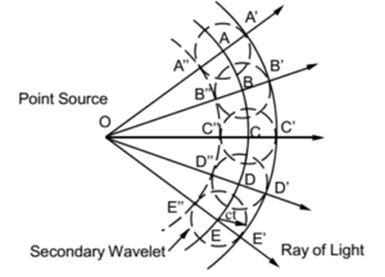
You have a point disturbance at O, in this case light emitted by a stationary source. With water waves, O is where the stone hits the pond. After a certain time, this disturbance will have spread out in a circle, to the points A B C D E in the diagram. These point disturbances combine to form the wavefront, the crest of the wave as it spreads out.
We then take each of these points on the wavefront and treat it as a point source of disturbance in its own right. The point A creates a circular disturbance around itself. After a time t, this “secondary wavelet” will have propagated a distance ct in all directions, if the speed of the wave is c.
These secondary wavelets will pile up and form a wavefront going outwards, these are the points A’ B’ C’ D’ E’. This is exactly what we see — the initial point disturbance creates an expanding ring.
So far, so good.
However, the secondary wavelets don’t only propagate outward. They also propagate inward. I often used compasses and pencil to construct the secondary wavelets, I found it very satisfying. There’s no way you can hide that inward-moving wavefront, the contracting secondary wavelets are even more tightly compressed than the outgoing ones.
I had no idea as a kid what an inconvenient truth this simple diagram represented.
These ingoing secondary wavelets pile up to form an ingoing wavefront, A’’ B’’ C’’ D’’ E’’. Take a look. Since this circle is contracting, the wavelets are even more densely piled together.
So why don’t we see an ingoing wave, when we throw a stone in a pond?
If you wait long enough, you will, because eventually the boundary of the pond will reflect the wave back inwards. But the ingoing wave in that diagram is not a reflection of any kind. Huyghens’ diagram insists that an outgoing wave, in sustaining its outward expansion, produces an ingoing wavefront.
My grade 11 textbook says that a proper analysis shows that this ingoing wave gets “cancelled” and this is why it’s not seen.
This was the exact puzzle that took me into a physics degree. I wanted to see this calculation showing how the ingoing wavelets cancel. As far as I could see, that ingoing wave was as real, was as energetic as the outgoing wave.
And yet it vanishes, the textbook says. Where does that energy go?
In our second year, we had our first proper course in electrodynamics and Maxwell’s equations. In the first lecture, we derived the equation for the propagation of electromagnetic waves. There were two solutions to this equation. One was an outgoing wave; the other was an ingoing wave, essentially the time-reverse of the first.
The lecturer then took his chalkboard duster and literally erased the time-reversed solution from the board. “This time-reversed component is unphysical, so we ignore it,” he said, or words to that effect. And that was that.
I was furious as we left the lecture room. I said to a friend, I want my money back. This is a complete fraud.
He agreed. He later became head of physics at an American college, he was a very bright guy.
Over the decades, I looked and looked for any treatment that showed the ingoing wave cancelling.
There is something called Fresnel’s obliquity factor, an entirely arbitrary cosine function that is deliberately set up to cancel the inward-going wave. It’s an experimental fudge factor that was introduced to fix some diffraction results.
However, there is a newish paper in Nature I hadn’t seen, from 2021, which has the title: “Huygens’ Principle geometric derivation and elimination of the wake and backward wave”. There are some quite terrifying equations in this study. It does explain quite clearly why there is no wake behind the expanding wavefront.
However, in pinning down exactly what it was saying about the backward wave, I found the paper very difficult to follow. I went to the abstract for clarity, which says, quite plainly:
As for the backward wave, a source propagates both a forward wave and a backward wave when it is stationary, but it propagates only the forward wave front when it is advancing with a speed equal to the propagation speed of the wave fronts.
So if you are a stationary source, which is what our diagram shows, then you propagate a backward wave, period. Exactly what happens to that backward-moving wave when it converges on its origin, the centre of the circle, is another story. This is where we will shift gears and see what Richard Feynman had to say about this scenario in his first published work.
The part in the paper I was not following is when the source advances with a speed equal to the propagation of the wave front. This is like a speedboat riding along with the waves it is creating, or an aircraft riding along with its own sonic boom, a completely different and much more complicated situation to the one in the standard Huyghens diagram.
Just to check, I asked Perplexity if this statement in the abstract was sufficient to establish the reality of the backward-moving wave:
Yes, you can accurately quote that abstract statement from the 2021 Nature Scientific Reports paper (“Huygens’ Principle geometric derivation and elimination of the wake and backward wave,” s41598-021-99049-7) to assert that a stationary source propagates both forward and backward waves, establishing the backward wave’s reality at emission.
Now please take a look at the title of this paper in Nature, the world’s top scientific journal. It quite clearly states that it shows “elimination of the … backward wave”.
And you can see it says quite clearly in the abstract that “a source propagates both a forward wave and a backward wave when it is stationary”.
Something is not quite sitting right here, do you agree? Do you think this paper should maybe have been published with the more correct title, “… and confirmation of the backward wave for a stationary source”?
I wrote yesterday that the physicists lie about this very topic, waves in a pond. I found this paper today and I feel it provides pretty convincing evidence that they are still obfuscating the pristine truth of those Huyghens constructions that any kid can make with pencil and compasses.
The ingoing wave is real and carries just as much energy as the outgoing wave. Only it concentrates this energy at a focus, instead of dissipating it outwards.
Can anyone think why they keep this ingoing wave a secret?
Spoiler alert: If you don’t know the story, check out Viktor Schauberger and the very well-kept secrets of “implosion energy”. Another story for another day.
5. The Lacework of Connections to the Future
The sun would not radiate if it were alone in space and no other bodies could absorb its radiation. ... If for example I observed through my telescope yesterday evening that star, which let us say is 100 light years away, then not only did I know that the light which it allowed to reach my eye was emitted 100 years ago, but also the star or individual atoms of it knew already 100 years ago that I, who then did not even exist, would view it yesterday evening at such and such a time. — Hans Tetrode
This exact quote, which is often paraphrased, comes from the first paper published by Richard Phillips Feynman, with his mentor John Archibald Wheeler, in 1945.
Later that year, as one of its creators, Feynman would watch the first atom bomb being tested. He was the only person who didn’t wear protective goggles, figuring the windscreen of the truck he was in would absorb any UV rays. It was a mistake. After he ducked down from the brilliant flash, all he could see was the purple after-vision of the blast.
The Wheeler-Feynman paper is about “absorber theory” — the notion that all electromagnetic radiation has to be absorbed, in fact that light cannot be emitted unless it “knows” that it is going to be absorbed somewhere in the future. This idea is beautifully captured in the quote above from the physicist Hans Tetrode. It was Albert Einstein who alerted Wheeler and Feynman to Tetrode’s theories.
Absorber theory, because it’s about light, is based in Maxwell’s equations. These are symmetric in time, as pointed out above. The equations clearly show waves going into the future and waves going into the past.
We’ve already seen what physicists do with the latter. They literally erase them from the chalkboard. Their argument is unassailable: we don’t hear radio broadcasts from the future.
This may not be exactly true. The Soviet cosmologist Nikolai Kozyrev used extremely sensitive detectors in his 50-inch telescope, including photosensitive bacteria. He worked out the exact position in the sky a star would be, if a flash of light from Earth in the present reached it in the future. Using the principle of reversibility of light — if you can see me, I can see you — he then looked at that point with his ultra-sensitive apparatus. And he claimed that he detected faint, but identifiable light from that star, light shining from where it would be far into the future.
The experiment was successfully repeated by astronomers in Crimea more recently, I have the paper somewhere.
Just saying.
Nonetheless, it is inarguable that we don’t switch on our radios and hear tomorrow’s news. Light generally seems to propagate one way, from the present into the future.
Wheeler and Feynman set out to find symmetric solutions to Maxwell’s equations. Their paper is complex, and the situation with many charges radiating is very difficult to analyse. However, they did come up with a scheme that integrates waves moving both forward and backward in time in a symmetric way, consistent with causality.
The light waves moving backward in time converge to a point, exactly like the inward-moving waves in the Huyghens treatment.
What happens when the converging wave reaches the centre? It was Feynman who created the following picture. When he says “advanced field”, he means these converging waves going from the future into the past:
The advanced field of a single charge of the absorber can be symbolized as a sphere which is converging towards the particle and will collapse upon it in just the moment when it is disturbed by the source. … The sphere converges, collapses on the source, and then pours out again as a divergent sphere. An observer in the neighborhood will get the impression that this divergent wave originated from the source.
My emphasis. The ingoing wave passes through the centre and now appears as an outgoing wave. I call this the “in-gone” wave, once it has passed through the centre.
There’s a peculiarity about Maxwell’s equations. They are actually fluid equations. Maxwell postulated a “luminiferous ether” that carried electromagnetic waves in the same way water carries water waves.
This means that all the phenomena you see in water waves also apply to light. It is perfectly valid to make inferences about electromagnetics by studying waves in a pond.
The experiment that proved the ether does not exist, and that light always travels at the same speed, set up Einstein’s relativity theory and changed physics forever. Suddenly we had a handle on that slippery stuff, “time”. It was just like space, only it stretches out at a certain speed. It stretches out at the speed of light.
Richard Feynman insists that even if light didn’t exist, the universe would still be stretching out at the speed of light. It’s just how time and space combine, to form spacetime. See from 15:50 in the following video.
There’s one other little difference between space and time, however, when you draw those axes and plot those motions.
Space is real. Time is imaginary.
This will become very significant later, when we discuss exactly what happens when you derive the probability distribution from Schrödinger’s wave equation.
In his Nobel lecture, a true tour de force, Feynman describes the evolution of his ideas. It’s really all about his initial work with Wheeler, including absorber theory.
That was the beginning, and the idea seemed so obvious to me and so elegant that I fell deeply in love with it. And, like falling in love with a woman, it is only possible if you do not know much about her, so you cannot see her faults. The faults will become apparent later, but after the love is strong enough to hold you to her. So, I was held to this theory, in spite of all difficulties, by my youthful enthusiasm.
You never hear of absorber theory in contemporary physics. It’s a historical oddity. In quantum field theory, however, you’ll find that they routinely have “operators” going backwards in time and performing all kinds of functions. It’s a mathematical convenience.
Just saying.
This was the conclusion of Feynman’s epic lecture:
So what happened to the old theory that I fell in love with as a youth? Well, I would say it’s become an old lady, that has very little attractive left in her and the young today will not have their hearts pound anymore when they look at her. But, we can say the best we can for any old woman, that she has been a very good mother and she has given birth to some very good children. And, I thank the Swedish Academy of Sciences for complimenting one of them. Thank you.
Two people have kept the flag flying prominently for absorber theory, John Cramer and Ruth Kastner. I am going to give the briefest possible outline of their “transactional” approach, based on one of Cramer’s figures. He calls this diagram “the Wheeler–Feynman handshake” — a handshake stretching both forward and backwards in time:
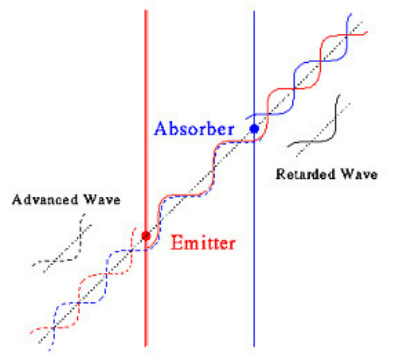
This shows the emission and absorption of a photon. The emitter is red, the absorber is blue. In line with Maxwell’s equations, the emitter sends out a wave into the future, the solid red wave; and also a wave into the past, the dashed red wave.
The terminology here can be very confusing. The wave into the future, the way radio broadcasts normally go, is called the “retarded wave”. What is actually retarded is the emitter — it is behind the waves, sending them forward in time.
The emitter will shake as it emits the wave. What’s really happening is that an electron inside an atom is emitting a photon and the entire atom will experience a recoil. I’m trying to simplify as much as possible.
This wave going forward in time is then absorbed by the absorber. In doing this, the absorber shakes and emits a normal retarded wave going into the future. This is the solid blue line. This solid blue wave exactly cancels the solid red wave, the incoming retarded wave from the emitter. This is how the absorber absorbs: by cancelling the incoming wave.
However, in line with Maxwell’s symmetric equations, the absorber will also send an advanced wave back into the past. This is the dotted blue line.
Please note that the dotted blue line is now riding exactly in phase with the solid red line. This is the handshake going forward and backward in time. What appears to be a wave carrying energy from emitter to absorber actually turns out to be two waves riding exactly together and reinforcing each other. However: one is going backward in time and the other is going forward in time.
How is this possible?
The ingoing wave, the dashed blue wave, travels backward in time and arrives at the source at the exact moment the initial emission occurs. This is precisely the situation Feynman described: “The sphere converges, collapses on the source, and then pours out again as a divergent sphere. An observer in the neighborhood will get the impression that this divergent wave originated from the source.”
You see the circular water wave spreading outwards on the pond. What is really happening is that the ingoing wave passes through the centre and carries on going, only now it’s an expanding wave. It’s riding right behind the original outgoing wave and reinforcing it. One more time: “An observer in the neighborhood will get the impression that this divergent wave originated from the source.”
When the advanced blue wave converges and arrives at the emitter, it exactly cancels the advanced red wave going back into the past, which was part of the whole symmetric initial emission. So there is darkness before the emission and there is darkness after the absorption. This is achieved through the cancellation of the advanced waves and retarded waves respectively.
You need also to remember that energy is being transferred from the emitter to the absorber. Then you have the whole picture. It is perfectly symmetric: no light, then light, then no light.
Imagine a microwave photon that is emitted here on Earth, which will travel in deep space. It may travel for billions of kilometres. We are still in touch with Voyager 1 via microwaves and it is 25 billion km away. It will soon take a whole day for our signals to reach it.
The photon may even travel for years, going at one light-year per year. We’ve been radiating microwaves into space for about 90 years, so we’ve polluted the electromagnetic environment for 90 light-years, about 850 trillion kilometres, in all directions. I suspect someone has noticed us by now.
What happens if a photon arrives from Earth and is absorbed by a rock on a planet a light-year away?
If the transactional picture is right, that photon will send a signal that travels backwards for one year, to arrive at the original emitter at the moment it emits the original photon.
The original emitter will feel a nudge, an influence, during the emission. This influence has actually come from far in the future.
There’s only one certain thing about this kick the original emitter gets. It’s not possible that this kick could bias the universe in such a way that that rock in the future is not there. Whatever the kick the emitter receives, can be guaranteed to ensure the existence of that rock existing in the right place at the right time to catch the incoming photon.
There is thus a tenuous photonic thread that connects us to this fragment of the future, that rock on a distant planet. And depending on how far photons travel before they are absorbed, so long are the threads that connect us to these isolated islands of the future, which may not yet exist, but will be there in time to receive our signal.
There’s an image that John Cramer uses that I really like:
… the emergence of the present involves a lacework of connections with the future and the past, ensuring that the conservation laws are respected and the balances of energy and momentum are preserved.
This image of a delicate lacework of photon paths that connects us with the future and the past is very potent, in my opinion. And for once, use of the word “emergence” is fully justified. The emergence of the present moment, no less.
You may be thinking this is all complete nonsense, the idea of a photon retracing its steps over billions of kilometres. Just consider this. It is fundamental in relativity that something travelling at the speed of light, like a photon, does not experience the passage of time. From the photon’s point of view, that journey of ten billion kilometres takes no time at all, it is instantaneous.
I cannot stress this enough. As the photon sees things, its narrative is that the emission, journey and absorption are one single unified event.
A fragment of the present and a fragment of the future have been melded into a single instantaneous happening, as far as the photon itself is concerned.
The very best way to see this is via Roger Penrose’s twistor space, which is maybe the deepest way to see spacetime. A light line in the real world — light travelling from A to B — is turned into a point in twistor space. A and B are squashed onto one another to make one single point. That is actually what the photon experiences.
I was going to write a whole section on this, I planned to call it “Let’s twistor again”, but I’m trying to keep this short. We’ll twistor again some day, never fear.
There’s one other place where you routinely see time reversal in quantum physics. Again, please bear with me. There is a wave function Ψ, the subject of the Schrödinger equation. If you want to find the probability distribution, the odds of finding a particle in a particular spot, you have to multiply Ψ by its complex conjugate, written Ψ*.
A complex number has a real part and an imaginary part, the latter being multiplied by i, the square root of negative one. To find the complex conjugate Ψ*, you take the imaginary part and reverse its sign. If it was positive, you make it negative, and vice versa.
The complex conjugate of 3 + 4i is just 3 – 4i. It’s not that complicated.
As I told you earlier, in spacetime, the imaginary part is time, t. So when you reverse the sign of the imaginary part … you are actually reversing the flow of time in the equation.
Paul Dirac had his own way of writing the function and its conjugate, called bra-ket notation, for “bracket”. The “bra” is <Ψ| and the “ket” is |Ψ>. When you write the function times its conjugate, you get the full bracket: <Ψ|Ψ>. You can see the two arrows pointing in different directions. It’s actually time that’s pointing in different directions.
It is worth spelling this out. In order to find the probability distribution at the present moment in time, you combine the whole of the past with the whole of the future. The present moment is all you have. There is no flow of time in quantum mechanics. There are only instantaneous snapshots. From these snapshots, you can calculate the probability that the particle is in a particular place at the present time.
Truly, quantum mechanics inhabits a Zen world, the eternal present. You can see how the wave function Ψ evolves over time using Schrödinger’s equation and take snapshots at other present moments, but these probability snapshots are the most information you can obtain of the quantum world.
Going back to absorber theory: it is very difficult to get inside and prove the existence of these advanced waves and whether this truly symmetric and elegant picture is correct.
I think, however, that if you look carefully enough, you begin to see startling evidence of its validity. You begin to see other apparently quantum phenomena, whole families and classes of entities in the “particle zoo”, entities so complex that it looks as though they may have bootstrapped themselves into existence via nudges from the future.
You begin to see discrete biological species.
6. The Origins of Species
In order to explain the origin and evolution of biological species, I need to assume one essential cornerstone: DNA, which is ubiquitous in living beings. How DNA came into being remains a mystery. The fact that DNA shows signs of being intelligently engineered is another story altogether.
There is a fundamental heresy in Darwinism, an idea so stupid that it is openly laughed at and derided. This is Lamarckism, the idea that you can influence your genetics through your present behaviour. That the giraffe, by stretching its neck, can start having offspring with longer and longer necks. The mantra is that acquired traits cannot be inherited.
This has been completely turned on its head by the discoveries of epigenetics and the fact that DNA is actually a dynamic structure that undergoes changes over an organism’s lifetime — changes that are indeed inherited.
In particular, methyl groups may attach themselves to certain parts of DNA to activate particular genes. This methylated DNA is then inherited by the next generation.
So the fundamental axiom of Darwinism has been completely shattered, but you very rarely see a hint of this in the mainstream media.
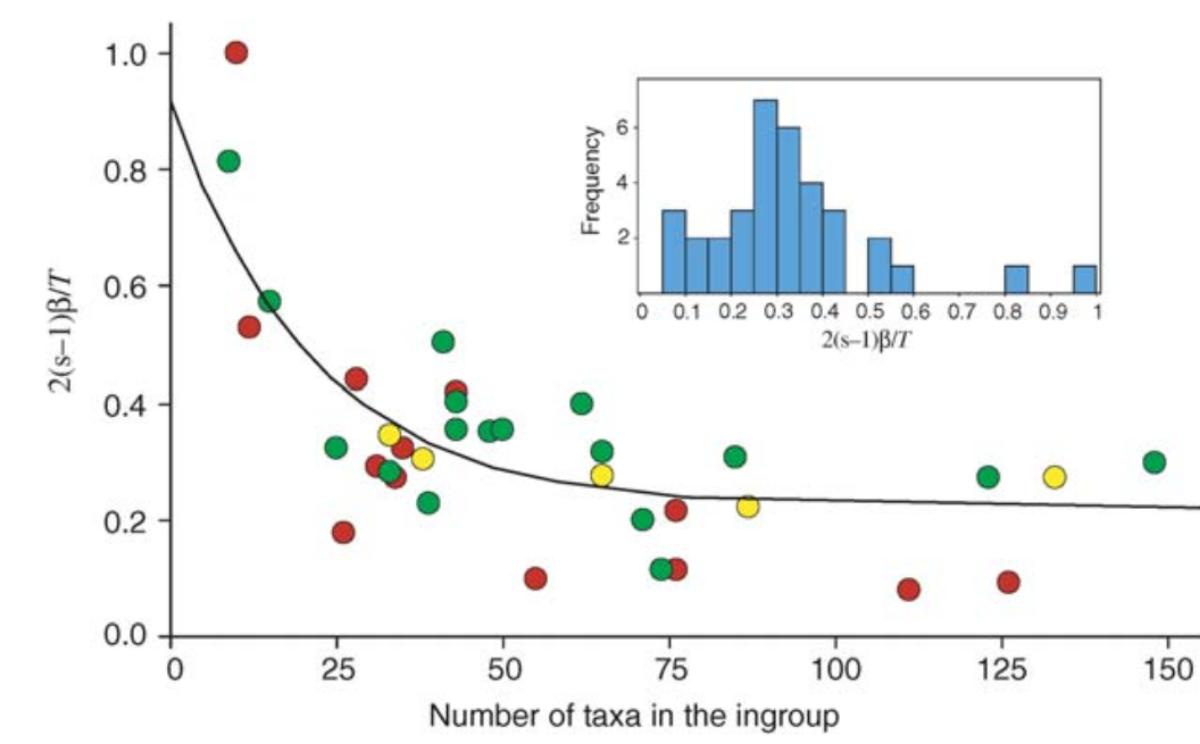
There’s been another challenge to the Darwinian picture of gradual change through small steps. The British researcher Mark Pagel looked at evolutionary trees and the frequency with which they branched to form new species, the process of speciation.
If speciation results from natural selection via successive small changes, this is the classic case where you would expect the branch lengths between speciation events to fit a bell-shaped curve.
In fact, out of 130 evolutionary trees, only 8 percent fitted a bell curve. By far the majority, 78 percent, followed an exponential curve. This curve is very familiar to physicists. It’s the decay curve of radioactive substances. It has a half-life, the period it takes for half the radioactive material to decay. You can see straight away from the graph that speciation is behaving in a quantum manner.
Quoting Pagel in New Scientist, 13 March 2010:
It isn’t the accumulation of events that causes a speciation, it’s single, rare events falling out of the sky, so to speak. Speciation becomes an arbitrary, happy accident when one of these events happen to you.
He says the key point from the evidence is that the trigger for speciation must be some single, sharp kick of fate that is, in an evolutionary sense, unpredictable.
I think what our paper points to — and it would be disingenuous for very many other people to say they had ever written about it — is what could be, quite frequently, the utter arbitrariness of speciation. It removes speciation from the gradual tug of natural selection drawing you into a new niche.
As it happens, I gave a talk in Johannesburg in 2003 in which I argued exactly for a mechanism like this creating species, and said that the different species we see are actually quantum phenomena par excellence. The talk was titled “Quantum Biology and the Arrow of Evolution” and featured the “handshake” graphic from Cramer.
Given DNA, I need only one extra mechanism to drive this process. This is the existence of biophotons being emitted by DNA. This was the great discovery of Fritz-Albert Popp, who died in 2018.
Using a sensitive photomultiplier, Popp showed beyond doubt that living beings emit ultraweak electromagnetic radiation in the near-ultraviolet. This radiation had been discovered in the 1920s by the Soviet researcher Alexander Gurwitsch, who detected what he called “mitogenetic rays” in the ultraviolet range, especially from growing plants.
Popp showed in a series of elegant experiments that this radiation was mostly coming from the DNA of living beings. It has been proven that DNA is a fractal antenna, emitting and absorbing electromagnetic radiation.
Popp showed that cells regulate themselves in real time through biophotons. One highly tuned biophoton can precipitate thousands of chemical reactions in the cell.
In orthodox biology, they tell you that within the cell, chemicals somehow manage to mix and then clear themselves within fractions of a second in response to rapidly changing situations. To my eye this is obvious nonsense, but then I am not a professional biologist.
Popp also showed that organisms communicate among themselves and with the wider ecosystem via biophotons.
These highly tuned biophotons work on exactly the same principle as lasers, stimulated emission. One biophoton can initiate a cascade of emissions of identical biophotons. Stimulated emission is a characteristic of tuned systems, like the DNA crystal. If Popp is correct, it is literally true that ecological communities interact via laser-driven communication systems.
With the use of modern cameras, biophoton emissions are now routinely photographed in the laboratory.
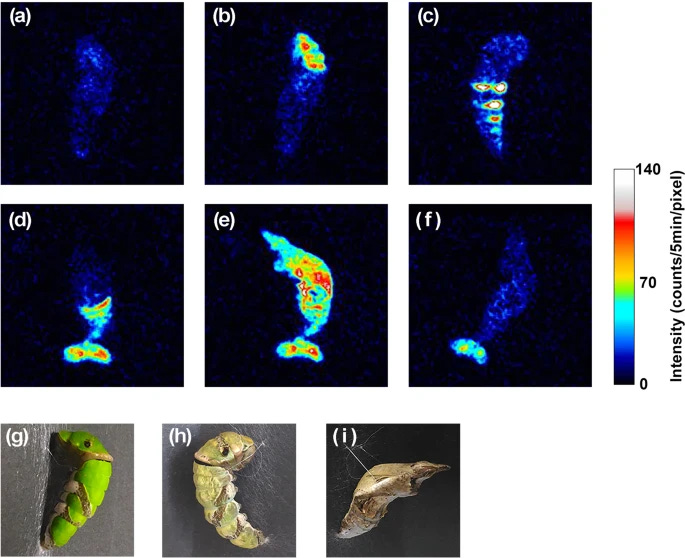
I am going to run a scenario past you and then we will do a simple thought experiment.
Let’s suppose that there is a particular species under extreme existential stress, maybe being hunted to extinction. Popp has noted that organisms particularly emit biophotons when stressed or injured.
If there is a very particular stress on a species, you can expect very particular reactions to be triggered within its members. Certain biophotons will be emitted with greater frequency by specific sections of these organisms’ DNA.
Stress in one individual will be communicated to the rest of the community through this radiation. It’s a horrible fact of laboratory life that when they “harvest” rats, i.e. kill them, they often have to do it in an entirely separate building from where the surviving rats are kept, or they will get very agitated. Somehow, even if they can’t see or hear anything, they know that something very bad is happening.
If there is some adaptation that could relieve the stress, some slip of the DNA that will produce a more fit organism, it’s likely that this will be associated with the parts of the DNA that are currently emitting biophotons as a response to stress.
The organism wants to return to equilibrium; it wants that biophoton storm to stop.
Every biophoton emission will be accompanied by some kind of “kick” to the entire DNA molecule. This is the recoil kick we discussed earlier.
Now just think. Every biophoton travels some distance before being absorbed. Some will be absorbed right there in the cell. Others will be absorbed in the environment, including in other creatures.
All of these biophotons, per absorber theory, will be sending back information from the future as to the situation out there in that environment.
Therefore, the DNA is receiving a series of kicks that actually come from the future, near and far.
Can you see that this is a radical mechanism that completely transforms the whole picture of evolution? If influences, nudges from the future are possible, then evolution becomes a completely different game.
Here’s the thought experiment. A creature in the present emits a UV biophoton, which flies into space and travels for 500 years, at which point it is reflected, travels another 500 years, and lands up back on Earth, where it is absorbed.
In other words, that biophoton has made a 1,000-year round trip back to the planet where it started.
Now suppose that there is a mutation that will ensure this organism’s survival. Let’s suppose that this mutation in fact occurred with the emission of this biophoton and the resulting “kick”, and that 1,000 years in the future, the original organism’s descendants are alive and roaming the plains.
Imagine that the original biophoton lands amid a clump of those descendants. This is just a thought experiment, bear with me.
That biophoton will send back an advanced wave that will “kick” the DNA of the original organism 1,000 years in its past. It will kick the DNA in some way so as to guarantee the existence of that clump of its descendants, 1,000 years ahead. The DNA gets the positive message of their existence straight from these descendants themselves, via the photonic lacework linking past, present and future.
If the kick to the DNA is big enough, it could even cause speciation — exactly the scenario Pagel was describing. Only it is not quite as random as he thinks. Information is coming from the future to bias the impulse the DNA receives.
One of the definitions of different species is that they are reproductively isolated, they can’t mate. Therefore if there’s a random mutation that produces one member of a new species, by definition that creature cannot mate with any members of the existing species. So how does the new species get off the ground? With whom can they possibly mate?
This huge problem in evolutionary theory is why they rely on genetic drift of isolated communities. The drift into becoming different species happens very slowly, through incremental small changes.
However, Pagel’s findings and the evidence of the fossil record show very sudden arrivals of entirely new species in the strata.
The arrival of one new member of a species will see a novel biophoton profile being radiated into the environment. Through stimulated emission, this may create cascades of similar biophotons in the existing species. Remember, all the other members are under the same stress, are radiating the same biophotons, are kicking the DNA in the same places. Rupert Sheldrake’s theory of morphogenetic resonance — when there’s one of a thing, it makes it easier for there to be more — is actually standard quantum physics, especially when it comes to stimulated emission.
To my eye, this mechanism can explain how a beneficial mutation, even an entire speciation, can ripple through a population and become established in a very short time.
Substack is telling me I’m near the email length limit. This is a good place to stop.
There is plenty more to this picture of evolution, including my proof of the Gaia hypothesis — the ecosystem as unit of selection, the ultimate quantum of life. I have an aphorism for this theory, not “survival of the fittest”, which is a dreadful tautology. It is: “Survival of the most fitting.”
Do you fit well into your ecosystem? And how many of you can fit?
Stay wired for the next instalment of this thrilling series. Expect the unexpected.
Fred, would you be willing to check out my papers and other works on my website, weavetheground.com..? I think you might appreciate it, and I would be interested in discussing with you if you're willing.