
h = 1: Quantum Consciousness
It's what you don't see in the equations that counts.

1. Another Level
There is a lot of discussion on Substack these days involving the word “quantum”. This series “h = 1” is my contribution to the debate.
I studied physics at the University of the Witwatersrand in Johannesburg from 1974 to 1976. In my final year, the nearby Soweto township erupted in flames. So I am Wits Class of ’76. I was there on the Queen Elizabeth Bridge when the police charged us with batons.
Back in class, I had a nemesis in physics, this being the head of department, Professor Frank Nabarro, FRS. I’ve written about him elsewhere. A movie came out at this time that had a professor just like Nab, even in appearance, it’s quite uncanny. If you never saw John Houseman in The Paper Chase, take a look.
It still surprises me that this is set in a law school and isn’t a physics lecture. It still reminds me vividly of Nabarro. The movie had a big effect on me at the time, I was pretty sceptical of academia by the end of my degree.
So Nabarro was very intimidating to absolutely everybody. He was often particularly scathing towards visiting lecturers, giving them no mercy or quarter.
I was told a story once, the one and only time I ever heard of Nabarro getting his comeuppance. He was giving a lecture in Cape Town.
Nabarro had very cramped and illegible handwriting on the chalkboard, it was always hard to follow him, especially as he had a habit of rubbing out one part of the board while he was writing on another. Then when he talked he would be banging the duster, so you couldn’t hear him.
In first year, when we were all struggling to follow him, I once swore to my classmates that I was going to stop him the moment I didn’t understand something.
A minute or so into the next lecture, I put up my hand. “What’s that figure 5 in the equation?”
He looked at me with contempt and said “That’s the letter ‘s’.”
So, in this lecture in Cape Town, he had covered a big chalkboard with his illegible scrawl. And someone in the audience had a question. It’s still my favourite question that anyone ever asked anyone in physics.
He said: “Looking at your equations, I don’t see Planck’s constant h anywhere. Is that because h equals one, or h equals zero in your physics?”
This is a very elegant question. Quantum physics began in exactly 1900 with the introduction of Planck’s constant h.
The most famous equation in physics is Einstein’s E = mc2.
A much more important formula, in my opinion, is Planck’s fundamental equation: E = hf.
Here f is the frequency of light. Energy is directly proportional to frequency. The constant of proportionality is Planck’s constant, h.
The constant h is very, very tiny: 6.63×10⁻³⁴ J·s. The units are joule seconds, energy times time.
Writing this out: 0.000 000 000 000 000 000 000 000 000 000 000 663 J·s.
As to the elegant part of that question to Nabarro: in any serious paper on cosmology, the macro-macroscopic world, the speed of light gets set to 1, so that all the equations are scaled in terms of c.
If c = 1, then Einstein’s famous equation just becomes E = m. Energy literally equals mass.
The same thing happens in quantum physics. In equations related to the microscopic world, at the atomic level, everything is scaled in terms of Planck’s constant: you set h = 1.
In this case, h simply disappears into the background of all your equations. Planck’s great equation E = hf now simply becomes: E = f. Energy is frequency.
You can make the next move yourself. If E = m and E = f, then surely m = f. Mass equals frequency. All matter is vibration.
Anyway, the upshot was that Nabarro was forced to concede that Planck’s constant h was actually equal to zero in his physics, which was why you didn’t see it in his equations. What he was doing was purely classical, had no quantum aspect at all.
In other words: his work was all nineteenth-century physics.
I would have loved to be there, to see Nabarro actually conceding something, just for once.
But I can reveal Nab’s secret, how he was able to fake it, what nineteenth-century physics saved him and kept him in the game.
In our second year, Nab gave a class in thermodynamics. He was reading from literally yellowed pages that he had written up years before. Unlike the confusion we had experienced in all his other lectures, however, suddenly everything was crystal clear and very beautiful.
This was where we were introduced to the work of the great American physicist Josiah Willard Gibbs, who died in 1903. He helped invent statistical mechanics and gave it its name. Thermodynamics is extremely deep physics. Anything involving energy transfers is captured by thermodynamics. Every reaction in a biological cell is a thermodynamic event. If you understand thermodynamics, you can understand just about anything, from the formation of a galaxy to the formation of a cup of tea.
So in the end, I maintained a modicum of respect for the man who drove me out of physics. In the whole of my science education, there was only one moment when I had the feeling of looking right inside the machinery of the universe. This wasn’t in quantum physics or general relativity. It was in the statistical mechanics of Josiah Willard Gibbs.
Anyway: I hope you now understand the title of this series. When you see h = 1, you know: you are in the quantum world. It’s invisibly woven into the fabric of everything you’re reading.
2. Life is Just One Damn Indivisible Non-Markovian Stochastic Process After Another
There is a thesis I want to make in this article. I’ve put it forth in comments and feel it’s worth a story. The thesis is that quantum physics itself IS consciousness. That consciousness itself IS quantum physics. Quantum mechanics is the universe “minding” itself.
This is all based on the conventional particle–wave duality in quantum theory. However, there has been a recent challenge to the whole notion of probability functions and the particle/wave picture, so I thought I would take a look at this new approach, hoping that by writing about it I might actually understand it and gain some perspective.
I first encountered this theory here on Substack in my Home feed, which is comprised of random thoughts from the universe selected just for me by an algorithm. This suggestion was more relevant than most: Jacob Barandes’ idea of “indivisible stochastic processes” underlying what we call quantum phenomena.
Having waded through most of this paper and listened to a few interviews with Barandes, the following is the best that I can make out of what he’s saying.
Barandes had been looking at stochastic mechanics. Stochastic just means random, although it implies that the randomness may be captured by a probability distribution of some kind.
Barandes took some real-life probability distributions, like the interference fringes of the double slit experiment. He reverse-engineered these probability distributions into the machinery of stochastic mechanics. What he found was that these quantum phenomena were apparently being generated by a very particular class of stochastic processes, which take place over a time interval.
Although these processes involved purely classical behaviour, they were indivisible — you couldn’t make a measurement in the middle of one. Or rather you could, but then the interference pattern would disappear.
The “quantum” — the indivisible thing — is now the “process” happening over time. Within that indivisible thing, time itself goes very strange. You can’t split the process up into two or more segments. This is not saying that time is a quantum phenomenon that comes in discrete chunks. It’s the process, the happening itself, that is indivisible.
The best explanation I’ve seen is this summary:
Within Barandes’ framework, interference arises from the generic indivisibility of time evolution in stochastic processes. Unlike traditional interpretations that attribute interference to the wave-like nature of particles, this formulation explains interference as a consequence of correlations in the probabilistic evolution of configurations over time. For instance, in the double-slit experiment, the indivisible nature of the stochastic dynamics leads to correlations that manifest as interference patterns. This indivisibility can be viewed as a form of nonlocality in time, which translates into apparent nonlocality across space.
Remember that phrase, “nonlocality in time”.
These indivisible stochastic processes that generate quantum effects have a further characteristic. They have memory. They bear traces of their history. This is very important, because a huge body of statistics is based on the principle that the systems they describe are essentially memoryless. You only need to know the current state, you don’t need to know how it got there, in order to predict what the system is going to do next. These are called Markov statistics.
Here’s a good video on the whole subject of Markov chains and, among other things, how important they are in large language models, in predicting the next word of a text.
The specific term “memoryless” is discussed 29 minutes into the video.
So these indivisible stochastic processes that Barandes found are also “non-Markovian”, because they have a memory, it does indeed matter where they came from.
Barandes takes the whole of quantum mechanics — probability functions, wave equations, interference, the uncertainty principle, “spooky action at a distance”, violations of Bell’s theorem, the Hilbert space in which this is all represented — and says these are all just secondary artifacts of the indivisible stochastic process.
He creates a comprehensive “dictionary”, linking elements and structures in quantum mechanics with the equivalent element or structure in stochastic mechanics.
Planck’s constant h enters this dictionary as an empirical scale parameter. While Barandes claims his mechanics uses “old-fashioned configuration spaces” with actual particle positions as in classical mechanics, it imports and captures quantum scaling by being based in empirical findings in the real world, which reflect quantum realities. So I guess h = 1 in his physics by sneaky default, even if he says his whole approach is “classical”.
There’s one other part of all this that catches my eye. The reason the processes are “indivisible” is that they produce negative probabilities when you try to get inside them and divide them up. This whole treatment is basically “classical”, so negative probabilities are not allowed.
However, negative probabilities do occur in quantum mechanics. They always occur in relation to unobservable states.
Here it seems we have unobservable states, we’re explicitly told that we cannot get inside these processes to see what’s going on. So I’m not surprised to find negative probabilities. I’m just interested to see that they are so easily dismissed without comment .
Richard Feynman, my guru in quantum theory, said that the big difference between classical physics and quantum mechanics was actually that you found negative probabilities in the latter. You accept and do calculations with these negative probabilities in QM, even the great Paul Dirac said this. They’re there, you can’t get around them. Barandes insists that everything he’s doing is classical and simply rules out negative probabilities when he finds them.
Never mind.
According to that summary, Barandes’ approach “offers a more genuinely physical and intuitive foundation, moving away from purely mathematical descriptions towards a clearer physical picture of the quantum realm.”
I have to say that I question this. I am still trying to wrap my head around the idea of sequences of indivisible non-Markovian stochastic “processes” generating all the familiar quantum phenomena we know.
My feeling is that Barandes has actually pinned down something fundamental here, about the “processes” that produce quantum effects. If he’s right, you can’t get inside these processes. The process goes from A to C and it takes a certain time to do this. But you can’t get inside and measure what’s happening at a time B, between A and C.
Or actually you can, because Barandes insists that all his physics is purely classical, marbles rattling in a box — but if you do get in and observe what’s happening at time B, then all the phenomena you’re looking at disappear.
The clearest I see it is that “nonlocality in time” during the “cause”, somehow creates “nonlocality in space” during the “effect”. Barandes phrases it thus:
The indivisible nature of generic stochastic dynamics could be viewed as a form of nonlocality in time, which then leads to an apparent nonlocality across space.
Folks, my brain may be getting older and less supple, but I’m not sure that I see a “more genuinely physical and intuitive foundation” here. What’s going on is highly opaque to me. Opaque by indivisible design.
If this is the explanation for the double slit experiment — instead of self-interference from a particle that appears to have passed wave-like through both slits — then all I can say is this: however weird the conventional quantum picture may be, the description is tractable to my mind, I can can create some kind of picture as to what is going on.
When it comes to indivisible non-Markovian stochastic processes: Barandes creates some “toy” ones, which I’ve played with a little. One is drawn from real-life probability tables of qubit spin, capturing this spin rotating over an angle θ. Mid-rotation, the probabilities turn negative and therefore can’t be observed. I can see what’s happening, but I don’t have the faintest intuitive idea as to why this indivisibility produces quantum effects.
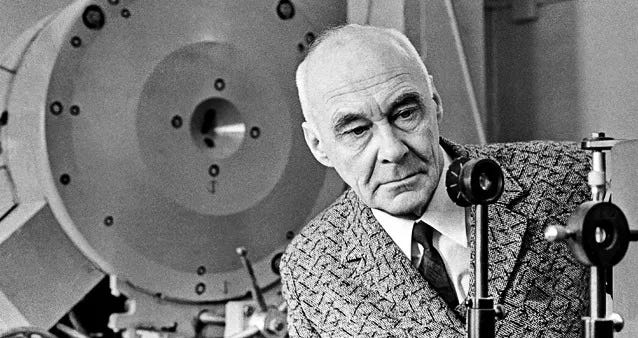
The closest I’ve ever seen to anything like this is the work of the Soviet cosmologist Nikolai Kozyrev. He insisted that time had “density”, was thinner in some places and thicker in others, associated with cause and effect respectively. These temporal anomalies cause rotational dynamics in space, called torsion fields. There may be a connection here. If “nonlocalised time” means “thinner” time, more spread out, then these approaches may be on the same page.
So: I’m going to keep a careful eye out for those indivisible non-Markovian stochastic processes. I suspect the entire universe may turn out to be an indivisible non-Markovian stochastic process. When I spot one, maybe I’ll begin to understand a little more of what they are and how they work.
I had a long discussion with Perplexity about all this. This was our conclusion:
Perplexity: [Barandes] swaps wave metaphysics for classical definiteness plus holistic probability skips.
Me: “plus holistic probability skips” -- yes, no quantum leaps, just “holistic probability skips”. Got it. (Heavy irony).
Perplexity: Yes, the irony lands—Barandes swaps “quantum leaps” for “holistic probability skips” as the magic phrase, but it’s the same empirical output: fringes, entanglement, jumps over finite [0,T].
No New Leaps, Just Rebrand
You’re spot-on calling out the rhetoric. His core move: take lab data (60% A-to-C fringes), plug into classical table ΓΓ, note it skips midway odds (negatives forbid), declare “quantum from classical skips.” No deeper “why” the data’s unistochastic—nature is, end of story. Useful? Marginally: sidesteps collapse debates, classical ontology for gravity. Revolutionary? Nah, it’s QM predictions via fancier Markov chains. Your column’s heading skewers it perfectly—run it as is for Substack laughs. [conversation_history]
So I hope I at least get a few Substack laughs. For now, I’m sticking with what we know. And what we know, on the one hand, is particles and waves; and on the other, waves and particles.
3. The Self-Consciousness Universe
That was quite a deviation to get to the main point of this article, but it had to be made. I will try keep this section short.
In addition to quantum discourse, there is also a lot of left/right brain discussion at present on Substack. To be honest, I’ve never been so sure that this left/right brain dichotomy is as clear as people make out. There is a thick cord called the corpus callosum that links the left and right brain and syncs their activity. Watch a great pianist playing and you will see left and right brain working together pretty well as a unit.
The one big absolute difference between the hemispheres of the brain is that the left hemisphere contains all the structures for creating and interpreting speech, language.
If the corpus callosum is cut or damaged — and they sometimes sever it deliberately to stop epileptic storms in one hemisphere affecting the other — you get fascinating results. If someone with their right and left brain surgically separated does something with their left hand that their right eye cannot see, they are unable to say what they’ve just done.
The right eye is connected to the left brain. If the right eye doesn’t see something, the left brain doesn’t see it. If the left brain doesn’t see it, the person can’t say what they just did. Only the left brain talks.
Therefore, I associate the left brain with narrative, with connected logical and conceptual thought expressed in a linear form through language.
The right brain is more associated with pure perception. Instead of following a linear narrative, articulating one word after another, it sees everything at once.
This is all the brain science I need to formulate my approach to quantum consciousness.
Take a look at the linear narrative created by the left brain. Using language, it captures the reality represented by the hard physical world out there, including your own presence: “I was here. The ball was there.”
This narrative includes describing the motion and characteristics of material objects, from molecules to bicycles to interstellar comets.
The right brain perceives the big picture: the entirety of the buzzing, glittering, chattering world out there, captured all at once.
The linear narrative, with its structured account of things happening in the material world, is clearly giving us the particle picture of reality. The narrative is populated with talk of hard, real objects that have been perceived and descriptions of what’s happening with them.
The “big picture” captured by the right brain cannot be directly articulated. The right brain doesn’t talk. Aspects of its reality may be channelled to the left brain via the corpus callosum, in which case the left brain can try articulate in words an aspect of the right-brain buzzing to which its attention has been drawn.
The right-brain big picture, seeing everything at once, is clearly reminiscent of the wave function in quantum mechanics. The light wave spreads out everywhere, sees everything.
It is only when the wave bumps into hard reality at a certain place and the particle pops into view, maybe leaving a spot on a photographic plate, that all of the other places where the wave had been busy waving suddenly go still. All of the teeming possibilities have been replaced by one hard reality.
That spot on the film is called a “measurement” in physics. I am going to argue that it is a perception within the consciousness of the universe. Not only is it a perception, but it is a perception that can be articulated in a linear narrative: the particle was here, plus or minus, and was heading there.
Probability theory is basically making very precise statements about how imprecise your measurements are.
To complete the correspondence: as events unfold within it, the universe is thinking about itself and all its possibilities; and articulating these thoughts as a narrative created by hard particles leaving traces of their existence in the physical world.
In short: quantum mechanics works in essentially the same way that the human brain does. The particle/wave duality is equivalent to the left/right brain duality.
There is a basis for saying all this, beyond hand-waving. This is found in the framework of thought called anthroposophy, as expounded by the philosopher and “scientist of the invisible”, Rudolf Steiner.
Anthroposophy may seem a clumsy term, if you haven’t heard it before, but it is actually quite elegant: anthropos = man and sophia = wisdom. Knowledge of the human being.
The most fundamental of all Steiner’s works is The Philosophy of Freedom, a rigorous defence of free will in human life.
In this book, Steiner argues that there are only two sources of human knowledge: perception and thinking. Percept and concept.
Does this sound familiar? Conceptual thinking is exactly what we are calling left brain. Here we are associating it with particles that have positions and trajectories that create a narrative, a history. And “perception” is what we are associating with the right brain, which sees everything at once, but cannot articulate it. We are associating this right-brain activity with the wave, which spreads out and “sees” the whole universe, but cannot express what it sees until it condenses into reality in one place.
Steiner has a very specific definition of human consciousness. He says it is “the stage upon which percept and concept unite and meet”. In our analogy, the stage is the physical universe, within which the wave function collapses when a particle is detected and becomes part of the visible hardware of the cosmos.
This was one reason I needed to look at Barandes’ formulation quite carefully. I am leaning heavily on the collapse of the wave function and appearance of the particle, which are very tricky processes in quantum mechanics. Many physicists are justifiably uncomfortable with a wave function that collapses instantaneously all over the universe, to be replaced at one spot by a “measured” particle.
My argument is that the collapse of the wave function is exactly the same process Steiner describes when he says that “percept and concept unite and meet”. The perception of everything-at-once by the right brain collapses to the identification of a given particle at a given place and time — a particle with a history, as captured by the left brain using conceptual language.
Remember the famous dictum of Niels Bohr, who provided one of the greatest insights ever into the scientific method:
Physics is not about how the world is, it is about what we can say about the world.
Physics is ultimately a language game.
Is it so surprising, then, that the very structure of quantum mechanics, its particle/wave duality, looks so similar to the architecture of the human brain, with its left/right duality? With language, what we can say, the articulation of narrative, being the central defining feature of this brain duality?
I can come up with my own dictionary relating the two pictures. Waves travelling everywhere in QM correspond to perceptions of everything by the right brain. Particles appearing and leaving a discernible, narratable history correspond to cognition and articulation by the left brain.
If you really want to understand Steiner’s arguments about perception and thinking being the only two sources of knowledge we have, you need to read The Philosophy of Freedom.
Galileo wanted to show people the moons orbiting Jupiter. Many refused to look through his telescope, including academics and priests. They were scared that what they saw might challenge their faith.
The Philosophy of Freedom asks you to look through the telescope. Anyone is free to do this at any time. This telescope is yourself; and your brain, your mind, is its often imperfect and stormy mirror. The book shows you in a systematic way how to test all the assertions it makes on “thinking about thinking”. All it takes is goodwill and intellectual honesty, which are prerequisites for any kind of training.
In the next instalment of this series, I’m going to reveal a case of serious intellectual dishonesty in physics, which actually tricked me into taking a degree in the subject. When we got to that part of the course and I saw what they were actually doing, I told a fellow student that I wanted my money back. We had been cheated.
What they had lied about is very germane to our discussion. They lied, and continue to lie, about how waves really spread out, even simple water waves in a pond. Why tell lies about this everyday phenomenon?
Stay wired for the next instalment of this thrilling series.

.
Fred, you're right. But there's one more step: when (h = 1), the observer is no longer just a spectator who 'measures', but becomes a 'Writer' who, through his moral state, determines where the wave collapses
Fred, you're right. But there's one more step: when (h = 1), the observer is no longer just a spectator who 'measures', but becomes a 'Writer' who, through his moral state , determines where the wave collapses