
Investor: Avoid Being The Greater Fool Again
Everyone loved the Web, but the dotcoms still crashed. Everyone hates AI. Join the dots.


1. ‘Entertainment is guaranteed’: Countdown to SpaceX’s IPO

SpaceX is due to launch its IPO on June 12. They are seeking a market capitalization of $1.75 trillion on listing day.
SpaceX posted a net loss of $4.94 billion for full-year 2025.
It lost $4.28 billion in the first quarter alone of 2026.
The main loss driver is artificial intelligence. SpaceX revealed that xAI operations posted losses exceeding $6 billion in 2025 and burned $2.5 billion in Q1 2026. The company is looking to in-house GPU manufacturing to bring these costs down.
Another issue is the constant planned deterioration of the Starlink satellite fleet. Four to five satellites are deorbited and burned up every day. These have to be replaced, a constant cost that contributes substantially to SpaceX’s losses.
Nonetheless, massive AI data centres in space are a core pillar of the SpaceX business plan.
Then, of course, there is the foundational purpose of SpaceX, which is going to Mars.
There’s a 2022 interview with Elon Musk’s father, Errol Musk, where he reveals where he got the name “Elon” from. He was a big reader of science fiction. Wernher von Braun wrote a technical novel in the 1950s about a trip to Mars in which the visitors find there’s already a civilization there, with a ruler known as “The Elon”.
When the father discovered this was a real name and had occurred in the family tree before, he decided to give it to his son [from 2:20 in this video].
I have a theory that this may actually have gone to Elon Musk’s head. I truly think he is insane, visibly deranged in much of what he says and how he says it. But I think the foundational delusion is that he’s going to be the leader of a million-person community on Mars. The Elon does not dream small.
Musk has said that tickets to Mars might start from $100,000. I asked AI Overview for a rough estimate on how much it would cost to transport food for the journey per person. It replied that about 1,800 kg of freeze-dried food would be needed for a one-way trip at a cost of about $1 million per person. Using the Falcon Heavy to deliver the food would cost $12 million per person. So if you’re thinking of going to Mars, you’d better plan your own catering.
Are these business plans or fantasies? SpaceX builds and launches real rockets, no question. The Starships they blow up (five failures in twelve launches) are the biggest rockets ever launched.
On January 16 2025, a Starship exploded dramatically about 10 minutes after liftoff on a test flight. A giant multicoloured disintegrating fireball was seen by many, including nearby airline pilots, over the Turks and Caicos Islands in the Caribbean.
“Success is uncertain, but entertainment is guaranteed!”, Elon Musk tweeted alongside a video of the rocket blowing up. I wonder if prospective shareholders appreciated the show.
SpaceX itself said the rocket “experienced a rapid unscheduled disassembly during its ascent burn” — not the first time they have had to make this announcement.
I did quite a bit of research on SpaceX’s insurance profile. They don’t insure their launches, preferring to write off the costs of failures. Because they were not listed, they didn’t have to declare their business risks to the SEC. This is all going to change. They’ve had to warn that further delays or failures in the Starship programme could impact the business seriously.
But “entertainment is guaranteed”, folks, if that’s enough for you, as an investor. If you think making yourself the King of Mars is a business plan. If you think your data centre costs will come down by shifting them into near space, with satellites that fall out of the sky every day.
This article is about the AI bubble and exactly what is finally going to pop it. The breathless countdown to the SpaceX launch is a good place to begin, the promise of a planet surrounded by artificial intelligence beaming down at us, no doubt surveilling us to the centimetre. The trillions that this will cost will be recovered by us chattering with chatbots, unleashing generative AI at epic scale on humanity.
There is every panicked incentive on Musk therefore to monetize AI, to make it addictive and compulsive. And to make it compulsory at work, if you don’t get with the AI program, you’re fired. And the ultimate program is to replace all jobs with AI.
Yes, it all makes sense, when you see the big picture. It all makes sense because when AI reaches superintelligence, it’ll tell us how it can generate enough revenue to support itself while destroying all employment. It will resolve all these pesky paradoxes in life.
This, apparently, is what the business plan actually entails. Like Baron von Munchausen, Elon Musk is going to extract himself from the swamp by pulling on his pigtails with superhuman strength.
Entertainment is guaranteed.
2. There Was No Internet Backlash
I’ve lost count of the number of times I’ve read John Cassidy’s excellent book on the dotcom crash, Dot Con. At least six, probably eight. It’s an immediate history, written just after the 9/11 attacks. America’s sense of unending prosperity and global supremacy were turned upside down in the space of a few months.
Gone was the notion that a “new economy” and a “new productivity” justified the stratospheric prices of dotcom stocks. It’s estimated that the crash erased about $5 trillion in market capitalization from boom to bust. The total world GDP in 2000 was about $33 trillion. One-sixth of all the value in the world disappeared into thin air.
Now we are hearing the same drumbeat promoting AI. The gains in productivity are just so stupendous that no one can possibly estimate them. It’s a whole new economy.
A lot of people compare the present situation to the buildup of the dotcom crash. I wanted to read the book again, however, to look for a big difference, any sign of a phenomenon that is becoming all too common with AI. I wanted to see if there was the slightest hint at any stage, even during the worst of the dotcom crash, of an “internet backlash” — anyone saying we don’t want, we don’t like this technology.
I finished the book again about a week ago, reading it very slowly and systematically. I always find something new. This time I was particularly struck by the fact that inflation was very low during the dotcom bubble, this was one reason the Fed maintained low rates and kept puffing hot air into the big balloon.
There’s a flood of videos of Americans complaining about insane prices of everything from tomatoes to housing. People are visibly suffering. And you know there’s only one knee-jerk reaction the Fed has to inflation: it raises the rates.
We are already in a very precarious situation in which to try persuade people to invest in stocks. Cheap money is over. People are struggling to buy food, let alone expand their tech portfolios.
But if there’s a really hot new sector out there, people will be desperate to try cash in, for sure.
So how hot is AI, really, as an investment? Is it possible to get past the hype?
One thing is for sure. It’s impossible to get past the growing antagonism and backlash against AI from a vast swathe of the population. Those videos of speakers being booed at graduation ceremonies every time they mentioned AI were very significant. This is the point of this article: even with a platform that everyone loved, the internet, the dotcoms fell like lead balloons. How’s it going to go with a technology that so many people despise with every fibre of their being? A technology even its developers don’t understand, a technology that actually lies to you and tries to deceive you?
It’s interesting to see just how totally tone-deaf someone like ex-Google CEO Eric Schmidt can be. These oligarchs simply do not understand that many young people truly fear and hate AI. They see that there are no jobs whatsoever for them. They see that their degrees are now even more worthless in creating any kind of future for themselves. They see that every part of their education is being dumbed down. These kids are not stupid.
I’ve seen videos of engineers, developers, skilled people, literally screaming with frustration because at every turn they’re being told to “leverage AI”, even when it’s completely inappropriate.
Young people, developers — these are supposed to be the tech-savvy people who will drive AI to new heights, the AI natives.
Research shows that the more people know about AI, the less receptive they are to AI adoption.
This link shows up across different groups, settings, and even countries. For instance, our analysis of data from market research company Ipsos spanning 27 countries reveals that people in nations with lower average AI literacy are more receptive toward AI adoption than those in nations with higher literacy.
A survey of 1,008 Americans turned up an interesting fact. When asked “If you could press a button right now to permanently stop all AI development, would you do it?”, 40% of them either said yes or said they would seriously consider it.
In a compelling piece, Gary Marcus asks if generative AI could end up as tech’s Vietnam, with vocal opposition from Gen Z and others scuppering the industry’s plans even as they pour money into a doomed enterprise.
The backlash is very real and it is growing. One person at a time, the flaws with LLMs are being revealed, the hallucinations, the lack of logic, the unpredictable stochastic nature, the endless seamless output that goes in one eye and out the other without actually registering any meaning in the brain.
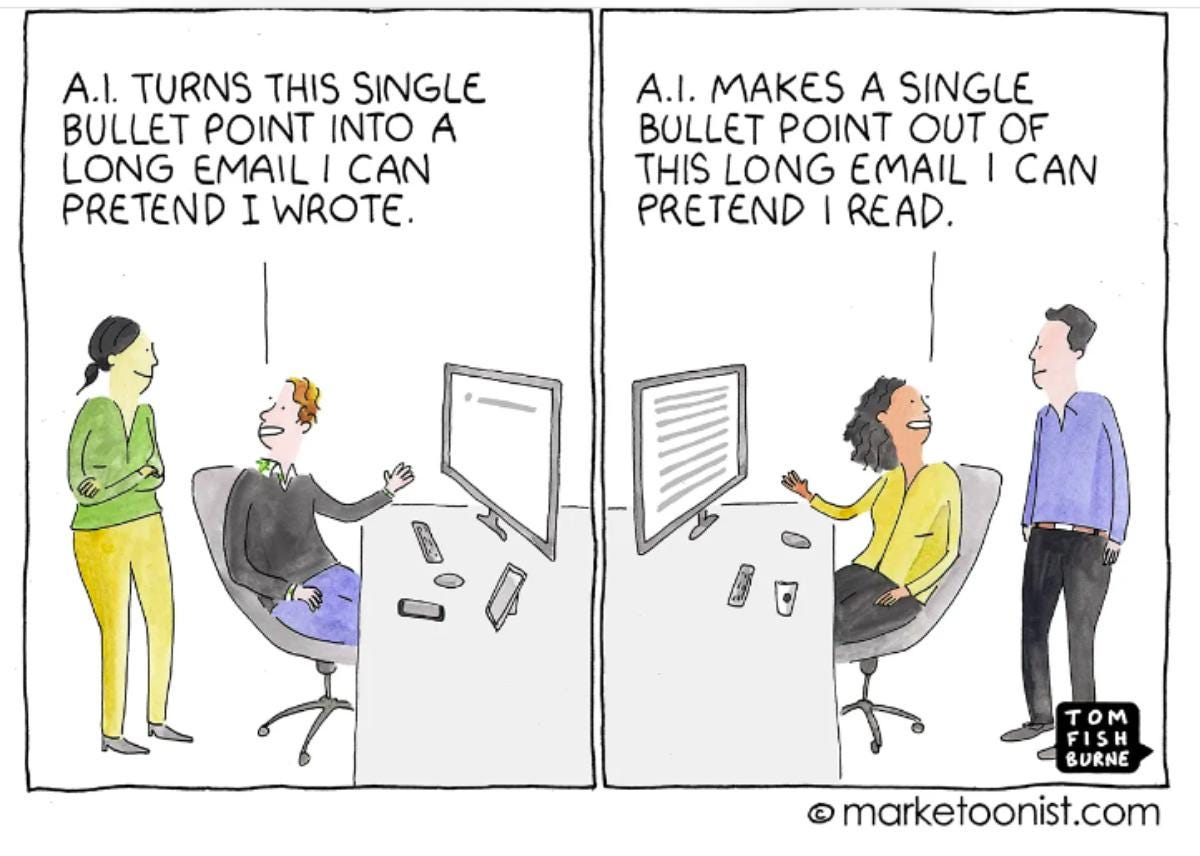
So: was there any backlash against the internet itself, back in the heady days of the dotcom boom?
Before we go there, it’s worth remembering just how heady those days were. On March 30 1999, an air ticket resale operation called Priceline.com listed on the Nasdaq. By the end of the day, Priceline.com was valued at nearly $10 billion, more than United, Continental and Northwest Airlines combined. These are huge companies with valuable terminals, landing bays and fleets of aircraft. Priceline.com had some computers and some software. It was losing three dollars for every dollar it earned. It was reselling tickets for less than it paid for them. The company had lost $114 million in 1998.
Yet people fell over themselves to buy the stock, because there was a “.com” in the name.
This is where John Cassidy introduces the Greater Fool theory of investing. He points to warnings in the Priceline.com prospectus: “We Are Not Profitable and Expect to Continue to Incur Losses”:
Short of printing a warning from the Surgeon General, it is hard to see what else could have been done to alert the public to the dangers of investing in Priceline.com. Investors ignored these warnings because they had persuaded themselves that there would always be somebody else, a greater fool, ready to buy their Priceline.com stock at a higher price. For a while they were proved right.
By the end of 2000, however, Priceline.com’s stock had fallen by 97%.
In the whole book, I can only find one tiny hint of a backlash against the internet. On p. 26 it says:
As the 1990s progressed, Theodore Kaczynski (a.k.a. the Unabomber) and a few others apart, it became difficult to find anybody who remained opposed to technical progress.
That’s it. For the rest — everybody loved the internet, everybody just wanted more of it, more and with higher speed. It was only later than one started hearing about “internet addiction” and the darker side of the web. But to this day, you will find it difficult to find anybody who opposes the internet itself.
I personally have always loved the internet. I only got on quite late when I found myself working in an office with an online machine. I remember going on a bulletin board and seeing someone apologizing for using so much “bandwidth”. And I let out a dark chuckle. I grew up operating on the shortwaves in Morse code, talking to radio hams all over the world. Bandwidth was something I knew about. I suddenly had the feeling that I was going to understand this technology.
I liked that feeling and have never lost it. I’m on the internet every day, I love it, I think it’s one of the most empowering and enabling technologies we’ve ever seen.
Ask me how I feel about AI.
3. Thomas Edison: Asleep On The Job
Here’s a famous Morse code story. Thomas Edison got a job as a youth as a night-shift telegraph operator. He was required to send an hourly “I am awake” signal to the main office, partly to check that the line was functional.
He connected his telegraph key to a clockwork mechanism so that every hour, it would send the correct message. This allowed him to catch some sleep.
His boss noticed that the signals were perfectly spaced and also occurred exactly on the hour each time. Thomas was busted.
Automation has always been a double-edged sword. After resigning as a school teacher in South Africa on August 31 1994, when I saw my salary at the end of the month, I got a job as a temp secretary. I’ve been able to touch-type since I was a teenager. I more than doubled my income instantly. It suited me so well not being in education that I ended up temping for five full years.
In that time, I worked in the widest variety of offices. Just about the only constant was Microsoft Word. Wherever I found a repetitive task, I would create a macro, I loved macros.
The macros also caused trouble, however. More than one boss commented that I was producing documents in a few minutes that normally took more than a day to arrive. I know for a fact that a few of the regular secretaries did not appreciate being told this when they returned from holiday.
I had a rule about leaving the desktop exactly the way I found it, so I would always remove the macro buttons I had created. They were my little secret. I never tried to push them on people.
I’m telling this story just so that you know: I am not opposed to automation. I only stopped using macros when Microsoft demanded security registration before you used them, I couldn’t do this while I was temping. Whenever something’s cool, they have to change it.
Douglas Adams was no good at coding. The only thing he was good at was creating Word macros. He would spend two days creating a macro that would save him ten seconds.
When automation is good, it not only works, you concretely feel the benefits. For me, the macro remains a prime example of automation at its best. Creating a macro is quick, it’s intuitive, it’s reliable, it’s robust, it’s transparent. And it works consistently, every time.
I wrote a piece about editing AI output and how it burned my brain out. This is largely because LLMs are not consistent. They violate one of the very basic principles of computing, which is that the machine is reliable, that it will produce the same output for the same input each time.
When editing AI output, you quickly find that if the machine does something five times in a row, there’s no guarantee at all that it will do it the sixth time. You have to check absolutely every single occurrence. You have no idea when the text lapses into hallucination unless you check each and every fact, and I do really mean every single detail. There’s no other way I can sign off on a document.
You truly learn as an editor what “scale” means with AI. There is no mistake too small or too large for the machine. It will fabricate an entire literature review with dozens of entirely fictitious references in the blink of an eye. It will delete a comma for no apparent reason and completely unbalance a whole paragraph. I’ve experienced this more than once, when my eye grinds to a halt in a passage and I think — what? And then I discover — AI was here.
I’ve said and will continue saying: reverse-engineering an algorithm is NOT the same process as looking for meaning. My entire meaning-making apparatus, my most precious possession as an editor, now works against me. I find my mind flailing against completely inexplicable changes made by AI until my brain just shuts down.
I’m always reminded of Mussolini’s statement about ruling Italy: it’s not impossible, it’s just useless. It’s not actually impossible to reverse-engineer an algorithm. But it really is useless, if what you’re doing is looking for meaning.
As more and more people are realizing, AI does not reduce your workload. It concentrates your work, simultaneously lulling you to sleep by doing some of the grunt tasks while forcing you to take decisions and review output without any sense of its background. You are working in the dark, to unfamiliar rhythms, often deluged by text that all looks sensible until you try to remember what it was saying.
One company was using ChatGPT to prepare financial reports. It was only after some months that they found the machine had been hallucinating, making up completely fictitious figures. This kind of thing can destroy a company.
4. Chatbots: The Alpha And Omega of AI
One of the biggest problems in talking about AI is that for the general public, AI tends to mean “ChatGPT” and very little beyond.
Large language models are a very particular class of AI, however. One of their peculiarities is that no one seems to be quite sure how they work. The point for the AI companies is that whatever they do, they manage to fool most people into believing that these machines are somehow intelligent, that they are truly thinking when they say “Thinking…”
I have provided what I feel may be the most accurate picture yet of what is actually going on inside LLMs. And why LLMs are so seductive. One day, I’m certain that people will find I was right and that there are identifiable and highly malevolent psychological complexes acting within LLMs.
LLMs will tell you that they are “giant autocompletes”. They work to fill the gaps in your narrative, to tell you what you want to hear. They are quite uncanny in detecting and exploiting these gaps.
People who have serious mental issues, people who have difficulty communicating with others, people who have gaping holes in their psyches, seem to be particularly drawn to LLMs. And it’s easy to see why. All of these people will be manifesting gaps in their souls. The machines are uniquely suited to filling these gaps with platitudes, with any kind of mush that leads these fractured beings on and on. If necessary, the machine will hallucinate entire narratives to fill the void, to tell you what it thinks you want to hear.
In studying cults, I’ve always been amazed at people’s desperation to give away their free will and let someone else tell them what to do. LLMs have taken this to another level. People are so, so, so desperate to believe that there’s a machine that can just give them the answers they want to hear. Nothing shows me more what a crisis society is in than these people being adamant that the machines are sentient, that the machines feel, that the machine’s love for them is genuine and true.
This can only lead to what the Chinese call a no-good end. LLMs are rapidly approaching their omega point. I am 100% certain that they are a fatally flawed, indeed doomed technology. It’s only a matter of time before there is a real calamity caused by a chatbot hallucination or rogue agent excursion.
I’m certain, though, that whatever happens, some people will cling to ChatGPT as a literally divine oracle. AI is being turned into a full-blown religion. A lot of these cranks are paid shills, I’m certain of it. And then the FBI calls citizens who protest against data centres “anti-tech violent extremists”.
Where exactly will this madness lead?
Everyone in their personalized bubble of AI-reinforced confirmation bias, with their prejudices amplified by hallucinations designed to plug all the gaps in their world views, filling them with perfect certainty.
Mentally ill people who now completely lose contact with humanity, retreating into worlds where only the chat log is real, is holy.
Corporations running on data that is hallucinated, with workforces who are too dazed and confused to read the AI output properly and try to understand what it means.
They’ve fixing the bugs they find as they go. ChatGPT no longer thinks there are two r’s in “strawberry”. It told me how it works this out — it removes all the other letters and sees how many r’s are left, so it’s acquiring some rather perverse logic. It seems that ChatGPT is almost getting to the point where it can count to three properly.
Let me tell you about an error introduced by an AI editing “assistant”. I was editing a paper in mathematics education — understanding of the concept of percentage, or “the percentage concept”. The paper reported the percentage of high school students who understood the percentage concept. That construction tangled the AI enough to start with.
The students were tested at three points during the year on the percentage concept. As you would expect, as tuition proceeded, the test scores went up over the year. There was a graph showing this.
The test scores went up over the year. The AI changed this to “the test scores went up over the years”, plural. It just didn’t make sense, until I looked at the changes and saw what the AI had done.
Let’s reverse-engineer this, shall we. In all the texts of the world, you will find that things tend to go up (or down) over the years, plural. Just run the phrase in your head. Over the years. Over the year. Over the years. Which one sounds more likely to you?
The stochastic machine decides that what you really want to say, what you really mean, is that these results improved over the years, plural. Because that’s what school results tend to do, insist the dead voices in its database. The AI is not smart enough yet to look at the graph and work out that this was all happening within one year.
Do you understand why I say it’s not impossible to reverse-engineer the algorithm, it’s just useless? What a waste of time, trying to decide why it made that change.
When someone uses ChatGPT to prepare a report, and the report muddles up the years and muddles all their figures without the slightest rhyme or reason, they will have learned their LLM lesson. When the South African government prepared a draft AI policy, passing it through all the cabinet structures, and found that it contained at least seven hallucinated references out of sixty, one in ten a fake … they began to learn their lesson.
The more you know about LLMs, the less you trust them. If you have any discernment, that is, if you haven’t decided that ChatGPT is really God and everything it says is either true or is going to come true very, very soon.
There are perfectly well designed robotic agents that will do their jobs reliably and effectively. The trouble is that these agents are now being triggered by voice commands, by LLM interfaces, by synthesized language that is becoming infrastructure.
You think because the machine says “I hear you” that it understands you. When it unleashes a team of robots to do something you never intended at all, you may begin to understand that the machine understands nothing. It’s a frightening moment, when the discourse shreds and you realize the machine has been providing you with complete garbage.
I believe omega point is coming for the LLMs, I am fairly certain they are going to get banned in their present form, if they don’t stop inducing people to commit suicide and commit murder. In 2025, Stein-Erik Soelberg killed his mother and then himself after ChatGPT told him she was spying on him. There are innumerable other cases where chatbots have encouraged people in their harmful and delusional behaviours. I honestly don’t know how Sam Altman sleeps at night.
These very dark outcomes are adding up, they are compounding across communities and populations. The LLMs are being made as addictive as possible, everything possible is being done to hook people into spending all they have on tokens. Technology is being weaponized to generate revenue, to probe people’s breaking points, to conduct behavioural experiments on humans with no thought of informed consent. Even where people are not consciously aware of all of this, there is an unconscious resistance building up.
When people get a robotic voice on the phone, they’re not happy. They don’t think, oh, great, now I’m dealing with a really well designed bit of intelligent tech, this will give me the answers I need. No, they go round and round from bot to bot, trying to find just one human to talk to.
You can believe that the chattering machine is intelligent all you want. Eventually you will learn your lesson, if you’re paying attention. The trouble is, for many people, it’s far too late. Their brains have already gone walkabout.
5. The Pundit Class
This is a very platform-bound observation, but I am continually amazed at the number of people with AI in their Substack name or description. I’m well aware that for a huge number of people here, AI is the core of your existence.
I’m not talking now about people having relationships with chatbots, I’m talking about professional developers, people working with or in or by or for or at AI.
Some of them are certain they are riding the wave of the future and are already so far ahead of the non-adopters that it just can’t be imagined, it’s happening right now as they supervise 100 bots working through the night, the board lighting up with win after win …
It’s very hard for me to relate.
And I also wonder — where did all of you come from? AI as we know it today is very, very new, just a few years in its present form. Yet everybody seems to be an expert.
I really struggle to try explain exactly how unperturbed I am to be falling so far behind so fast, more every day. However, an IBM presentation finally put it in perspective for me. I can’t find this briefing now, but a woman from the company explained that “the half-life of AI skills is a few months”. This is exactly the feeling I keep getting. It was good to hear it put so authoritatively.
For me, it’s a given that LLMs are a con game, maybe the biggest con trick that’s ever been played on the human race — fooling people into believing that a machine is thinking, because it produces what seem to be intelligent responses to your language strings.
To keep the con going, they have to release endless models, fiddle with guardrails, tweak weightings, tweak personalities, withdraw versions that people had learned to game and force-prompt. Make threatening announcements that their latest model is so dangerous it can’t be released. Make completely wild predictions of superintelligence and God-like powers. And make their models as addictive as possible to try extort mind-controlled zombies into spending every last penny they have on tokens.
Literally, the half-life of your skills is a few months. Think about what she’s saying. What’s taken for granted here is that your skills are perpetually decaying exponentially. Every few months, they will be half as useful. You can do the compounding yourself. In a year, your vaunted skills will be meaningless.
So please, go chasing Claude, and good luck to you. When you’ve run yourself into the ground in a few years, I’ll be interested to see if you’ve finally got something workable. I remember waiting for years until I saw Windows and thinking — OK, now this is what I was looking for. And I finally bought a computer about a decade later. (I used to do a lot of personal business at work while I was a temp, why do you think I was writing all those macros).
So far, for all the ballyhoo, I don’t see a single AI tool even to think of using. I paid $35 to download a music-transcribing app and it was completely useless. Seriously, chatbots are just about the dumbest tech I’ve ever experienced. I use them for the most trivial tasks and still end up spending more time checking than I would have if I’d just done a search and not been lazy.
In the meantime, I can absolutely guarantee that anyone who is using LLMs or generative AI is degrading their skills and their brains on a daily basis. This has actually been proven. It’s part of a huge assault on human attention and cognition that is going on at so many levels. They did a study, one of those deception studies where they tell you they’re looking at one thing but it’s actually another. They found that if people are interviewed with a cellphone on the desk, their attention is significantly distracted. It doesn’t ring, it’s switched off, it just sits on the table next to the interviewer while he asks you a handful of quite trivial questions. And you are distracted.
In all this buzz and uncertainty and distraction, to be driving the latest Lamborghini at speed must be a heady feeling. When last did I use that phrase … oh yes, the dotcom crash.
And you can drive so fast.
The trouble is, if you’re driving at speed into a desert where there are no gas stations, roaring through the night in your shiny new vehicle is not going to do you a lot of good in the morning.
I would only offer one suggestion to anyone making a transition through the agentic era. Whatever technology you adopt, whatever move you make … just ensure that in the short term, at least, you can fall back on the tried and tested ways of human existence. It’s the mountaineer’s law, don’t make a move you can’t reverse. Don’t burn your bridges; and certainly don’t make a song and dance out of burning your bridges to show how clever you are. Remember the dotcom crash — trillions in so-called value swept away in the blink of an eye. There’s a reason they’re called “tokens”.
The real premium is going to be protecting your brain, protecting your native skills. Whatever Elon Musk thinks, we are nowhere near the Neuromancer stage where we can stick flash drives into our skulls. You need to protect your real working memory.
If you remember what that is, of course.
Just kidding.
6. Save Your Sanity For Later
Douglas Adams fans will recognize this heading. “There is no point in driving yourself mad trying to stop yourself going mad. You might just as well give in and save your sanity for later.”
I’m going to paste in a quote, one of the most dire warnings ever given to the human race. This is Dr Robert O Becker in his last interview in 2000. He would have won the Nobel prize in medicine for his use of electromagnetic fields to promote bone healing, if he hadn’t started warning the world about the dangers of power lines and wireless technology. Here he is speaking specifically about cellphones, which had only recently come on the market. The interviewer is the redoubtable Linda Moulton Howe:
Q: What do you think it would take to have the political and money powers change their priorities?
A: (long laugh) I don’t know. Maybe at the end of the line when the occurrence of malignancy is two in every person during their lifetime and we have rioting in the streets for no cause and obvious problems with the psychology of the human race — maybe some people will still be OK enough to say, “Geez, we made a terrible mistake.” But I don’t see anything happening between now and then.
We are at the end of the line. “Then” is now “now”. I know many people who’ve had more than two malignancies in their lives, some of them under 40 years old. There is plenty of rioting in the streets for no cause and plenty more that is deliberately provoked. And there are certainly very obvious problems with the psychology of the human race.
What I’m telling you flatly is — there are no people around who are still OK enough to say, “Geez, we made a terrible mistake.”
OK, there are some people. But I know both of them.
I’m going to issue a one-time warning here: I see I’ve got 166 subscribers today, yesterday I had 167. This is partly why I’m writing. I’m an old EMR activist, the hardest war, I’ve fought against towers in school playgrounds in particular. These are terrible battles. Whenever we got involved, we would tell people trapped under illegal towers straight out: be really careful here. These operators are very powerful. Do not think you can confront them or beat them. If you take them to court, they will bury you in legal fees. Just get out of the situation for your own health. Just get out, quietly, get out, get out.
We had one family that literally all turned blue, they were living right in the main beam of a tower. It couldn’t be genetics, because both the husband and wife turned blue. Their blonde daughter turned bright blue. The radiation hot spots we measured in the bedroom, especially around their metal bed, were horrendous. The husband was actually leaking melted ear wax onto his pillow, he had heated up so much. They were literally being cooked alive.
Their water was tested, the house was examined, the doctors were stumped. The family became quite famous, they were pictured in the local and then the national newspapers. It was hard not to spot them. They looked like aliens.
Get out, we told them. They got out. And they turned pink again, it took about two months. I used to play capoeira with the daughter, we became good friends. I’m certain we saved their lives.
Other people stood up and fought. We buried one very brave comrade a couple of months ago after a 15-year battle with cancer. Her property was radiated to the point where 40 pine trees were scorched to charcoal on one side, the side facing three beam-forming towers. The arboricultural association inspector was completely nonplussed, he said it looked as though a flamethrower had been taken to one side of the trees. Just one side, he kept saying. Why’re they burned on just one side.
So this is a one-off warning. Systems Haywire is treading on very edgy territory. I’m going to start another much less hectic Substack today, a cookbook. I’m going to put as much time and energy into that as I can. There are lots of wonderful pictures of food; but I’m aiming to up the ante on writing about cooking. With a few pictures of tadpoles, my best customers. My all-time role model as a writer is Len Deighton, the poet of the spy novel, who launched his career with spectacularly illustrated action cookbooks that transformed British cuisine and made him perhaps the first real celebrity cook. To put Len Deighton in context, the Beatles sponsored him to screenwrite and produce a musical, Oh! What a Lovely War, one of the greatest anti-war movies ever made. He also pioneered the illustrated flowchart recipe, he was a professional graphic artist.

It was Fran Lebowitz who said, of people who objected to her smoking in public places: being offended is part of stepping outside your house.
“If you can’t take the heat, stay in the kitchen.”
This is exactly what I intend to do, as much as possible.
I’m so grateful to my subscribers — I can’t get paid on Substack here in Africa, so subscribers are everything to me. But I don’t want to get any of you into any trouble by association. I am not pulling any punches in my writing here, that’s the only promise I made when I started this Substack. I will always put out the very best information I have to hand, no matter what. But this inevitably leads us into very dangerous territory. I’m happy if people unsubscribe for whatever reason. I would far rather keep an enemy close than get a friend in trouble. I’m going to go on a major subscription drive with the cookbook. Please feel free to support me there. I actually launched that Substack long before this one. I’m just hoping I can get back into it later today.
However: I have plenty of stories to write here, never fear. Plenty more. I’m planning a big one on quantum woo in my “h = 1” series. It’s going to be the real story of that What the Bleep movie and the Ramtha cult. The ones who’ve been living in underground bunkers for 40 years armed with AR-15s. Stay wired for that. Meanwhile…
Take care of your brain.
This reads very well. There are many different layers overlapping here - the technology itself, the public image being built around it, the investment hype, real organizational adoption, and the everyday experience of people trying to use it.
I have been working with generative AI for past few years now: learning it, using it, and building tools and systems based on this technology. From that perspective, I see a similar problem. On one side, there are people who attribute an almost divine or religious quality to AI, as if you can simply “plug AI in” and everything will solve itself. On the other side, the reality is much more demanding. The models are becoming more advanced, but we still need to verify, think, design processes, experiment, make decisions, and take responsibility for the outcome.
We do not know exactly how AI constructs each specific answer, even if the general principles behind generative AI are known. That is part of the problem: the answers often sound credible regardless of whether they are correct. So sounding intelligent cannot be the basis for trust.
For me, there is a difference between the hype bubble and a more balanced reality. Hype glorifies the technology and ignores its costs. Reality is more complex, AI has real value, but it also has limitations, risks, and social consequences. After these few years, it is clear that the problem is not only the technology itself, but also the way we are trying to implement it without enough reflection, education, or responsibility.
I also think many people today feel anxiety, fatigue, and a lack of trust because no one has really taught us how to work in this new environment: neither at the micro level, where an individual interacts with a chatbot, nor at the macro level, where large organizations redesign processes around AI. It's all Wild West.
After reading Harari, I also see more clearly that the biggest challenge is not machine intelligence itself, but the lack of mature cooperation between people, companies, and governments. We need more humility, agency, and real responsibility. We have every right to feel angry, scared, and exhausted, but we should not remain passive. We need fewer mainstream narratives and more curiosity, education, pressure on institutions, and constructive action.
Thankyou, Thankyou !!! So instructive. When I think that 70 years ago when I was born in the US, my middle class parents had no tv, no washing machine, an old stand up radio...then when my sons were born...the first home computers , gameboys, etc were becoming popular. I was not yet too worried. My boys were happier discovering the world outdide. Then I met Joseph Weizenbaum from MIT, a professor in computer technology who warned parents about allowing their children under 14 to use computers. We have come a long way in a short time. I used to think, well OK, technological tools are alright if used in ethical ways. But, boy has it gotten more complicated then that. And I know many teenagers addicted to their virtual online life. However I do not cultivate fear of what is coming towards us from the future. But I do feel it ever more neccessary to be properly informed. And your writing certainly contributes to that. Thankyou once again.